



 Français
 Español
 Deutsch
Content
- 1 Understanding the Role of a Mattress Protector
- 2 Product Overview
- 3 Advantages of the Satin Stripe Surface
- 4 Easy Washing and Everyday Maintenance
- 5 Why the Fitted Stretch Skirt Matters
- 6 Comparison with Common Mattress Protection Alternatives
- 7 Manufacturing Strengths Behind the Product
- 8 Certifications and Responsible Production Systems
- 9 Why a Thin Protector Can Be a Better Commercial Choice
- 10 How to Select the Correct Size and Specification
- 11 Care Recommendations for Long-Term Use
- 12 Potential Applications in Different Markets
- 13 Supplier Evaluation and Order Planning
- 14 Frequently Asked Questions
- 14.1 What is the main purpose of this mattress protector?
- 14.2 Is it a thick mattress topper?
- 14.3 What fabric is used on the top?
- 14.4 What is the skirt made from?
- 14.5 What filling is used?
- 14.6 What is the standard size?
- 14.7 Can the protector fit every mattress height?
- 14.8 Is the protector waterproof?
- 14.9 Can it be washed in a household washing machine?
- 14.10 Is polyester suitable for regular bedding use?
- 14.11 Can the design be customized?
- 14.12 What should buyers inspect before bulk production?
- 14.13 Where is the product manufactured?
- 15 Conclusion
- 16 References
- 17 Product: Satin Striped Mattress Protector

A mattress is one of the most important investments in a bedroom. It supports the body every night, influences sleeping comfort, and often remains in use for many years. However, mattresses can be exposed to perspiration, skin oils, dust, accidental spills, friction, and everyday wear. Once these contaminants penetrate deep into the mattress, cleaning becomes difficult or impossible. A practical mattress protector provides a simple way to create a washable barrier between the sleeper and the mattress while helping preserve the mattress surface.
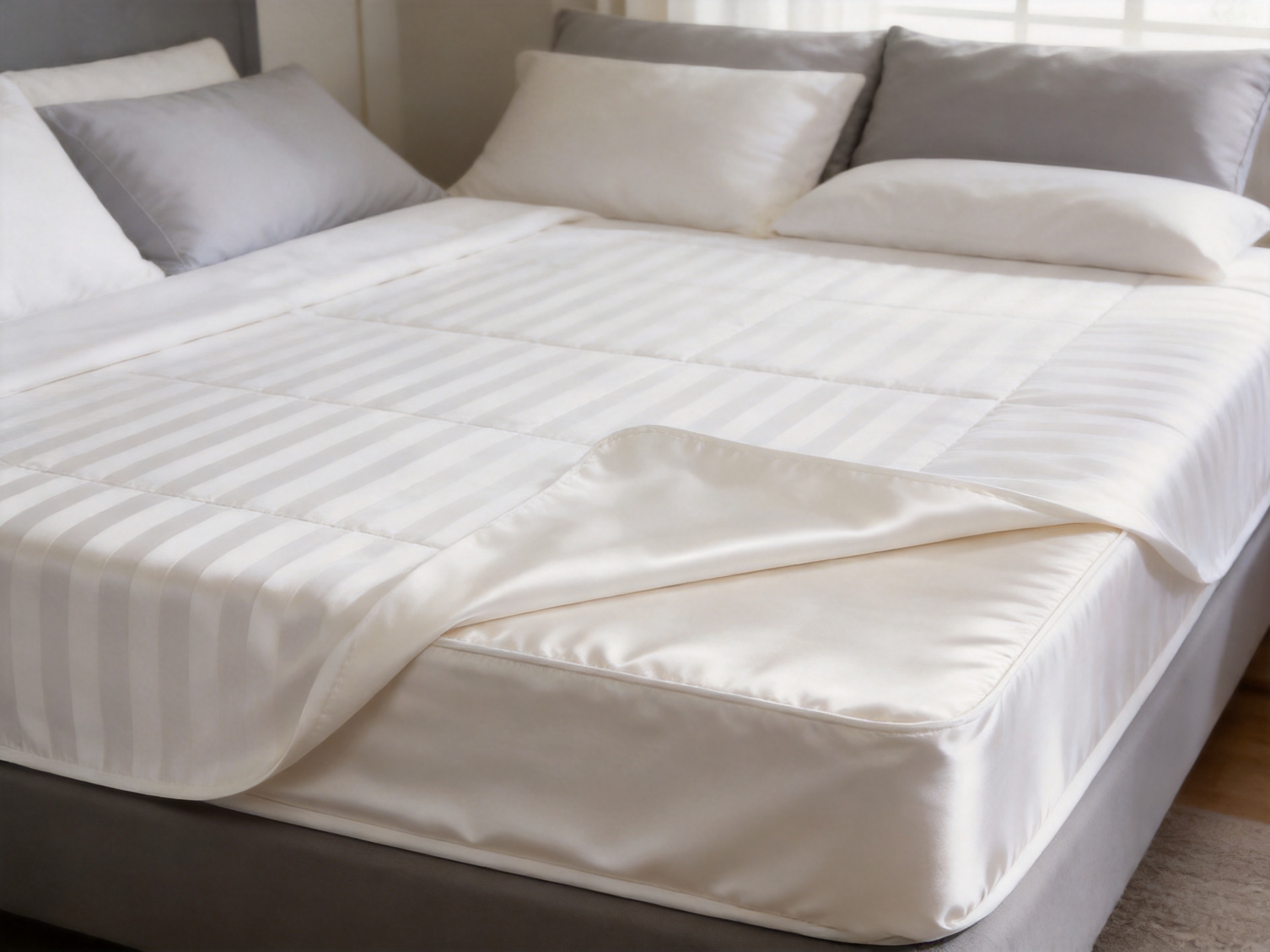
The Satin Striped Mattress Protector is designed for this purpose. It combines a lightweight satin stripe fabric surface, a stretch-fabric skirt, and a polyester filling layer. The result is a thin, washable bedding product that offers everyday mattress protection without the heavy bulk associated with thick mattress toppers or heavily padded protectors.
Its construction is especially suitable for households, hotels, dormitories, serviced apartments, rental properties, and bedding distributors looking for a dependable product that is easy to handle and simple to maintain. Available in a standard size of 160 x 200 cm or in customized dimensions, the protector can be adapted to a wide range of mattress specifications and purchasing requirements.
Understanding the Role of a Mattress Protector
A mattress protector is placed above the mattress and below the fitted sheet. Its primary role is to reduce direct contact between the mattress and common sources of contamination. Depending on its construction, a protector may also improve surface comfort, reduce fabric abrasion, and provide a more finished appearance to the bed.
Unlike a mattress topper, which is generally purchased to change the softness or support characteristics of a mattress, a thin mattress protector is mainly intended for protection and maintenance. It does not attempt to replace the mattress or significantly alter its firmness. This distinction makes it useful for consumers who are satisfied with their existing mattress but want a more hygienic and manageable bedding system.
The thin construction is one of the main functional advantages of this product category. A thick topper may be comfortable, but it can be heavier, more expensive, more difficult to wash, and more challenging to store. A lightweight protector can usually be removed, loaded into a domestic washing machine, dried, folded, and returned to the bed with less effort.
For commercial users, this ease of handling is equally important. Housekeeping teams can change protectors quickly, laundry departments can process them in larger batches, and distributors can benefit from more efficient carton packing and warehouse storage. These practical benefits contribute to lower handling costs over the product’s service life.
Product Overview
The Satin Striped Mattress Protector is a polyester-based bedding product categorized as a polyester mattress protector or bedspread-style protector. Its principal materials include a 100% polyester satin stripe fabric weighing 90 gsm, a 100% polyester stretch-fabric skirt weighing 90 gsm, and 200 gsm polyester filling.
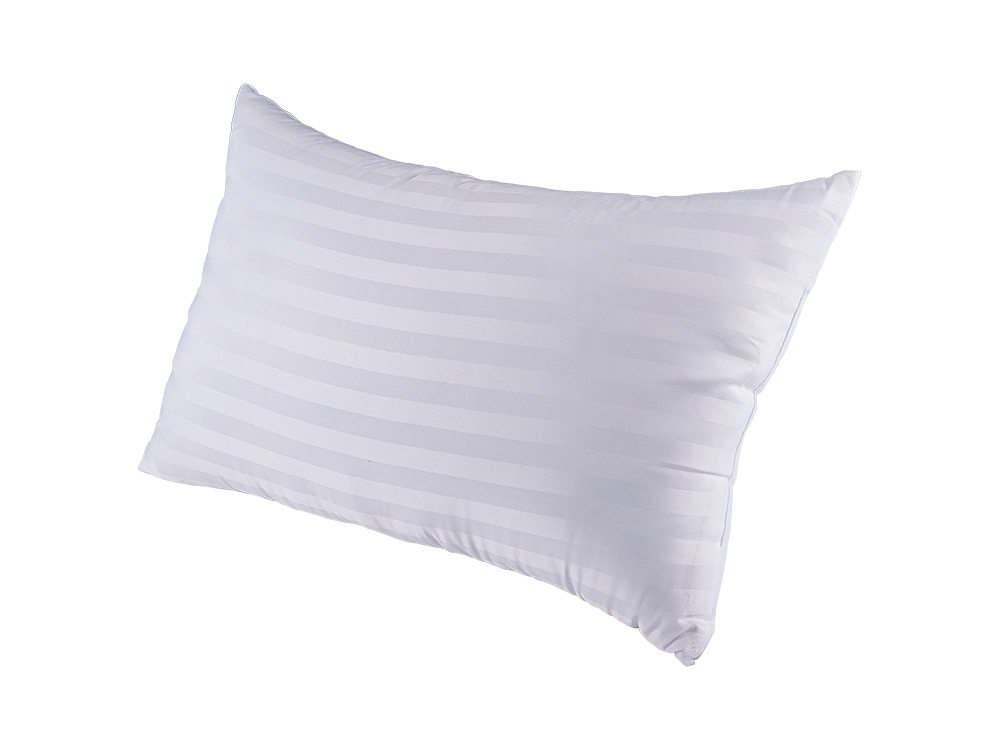
The top fabric provides a smooth and visually refined surface. The satin stripe construction creates a subtle linear pattern that adds texture and visual interest without using complicated decorative elements. This makes the protector suitable for a wide range of bedroom styles, from simple contemporary interiors to more traditional hospitality settings.
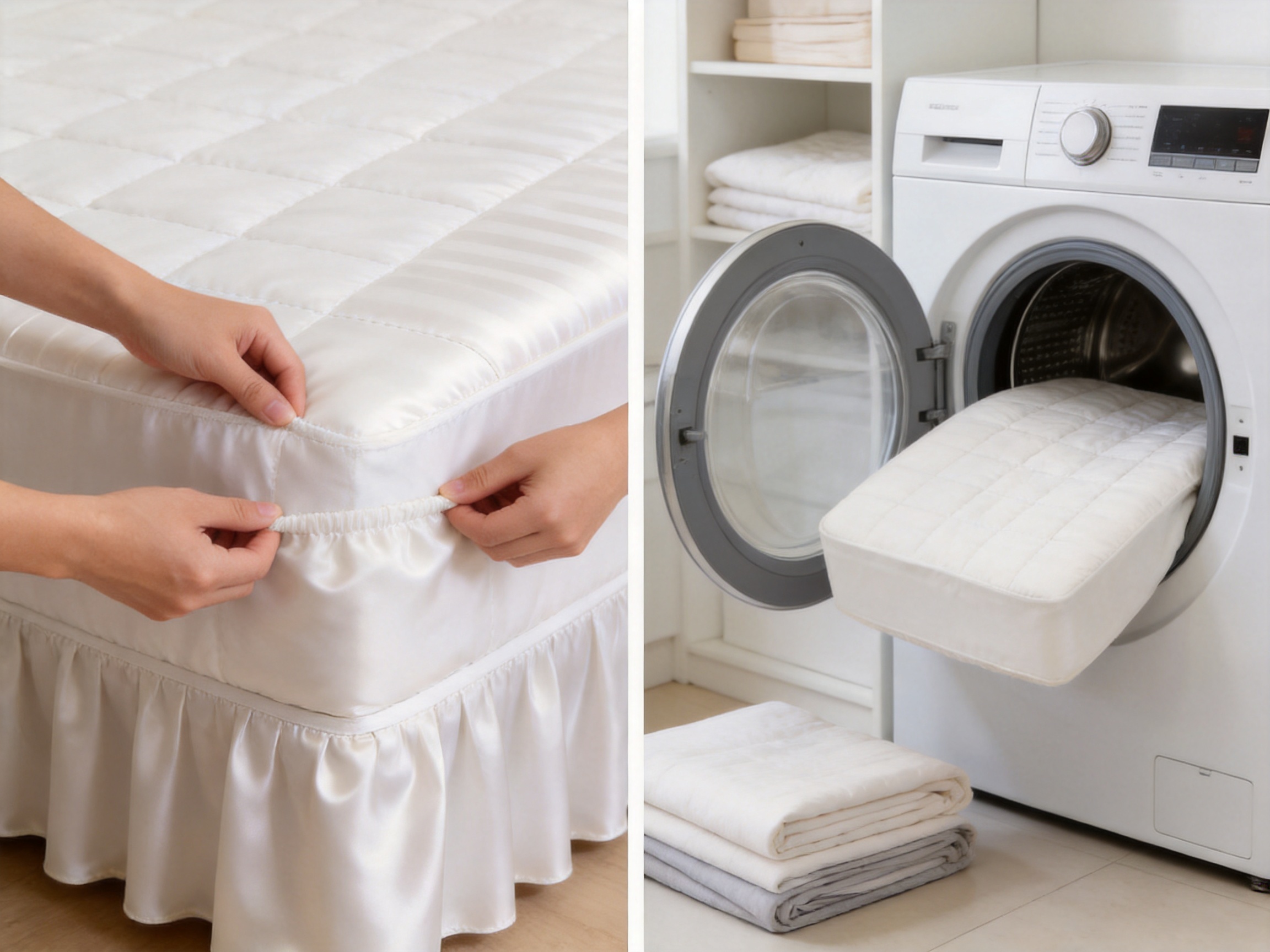
The stretch skirt is intended to help secure the protector around the mattress. Compared with a loose flat protective sheet, a fitted skirt can reduce shifting during sleep and help the product maintain a neat appearance. The elastic or stretchable construction also makes it easier to install on mattresses with slightly different height profiles, although exact suitability depends on the final skirt dimensions and product specification.
The 200 gsm polyester filling adds a light layer of cushioning while preserving the product’s thin and practical character. It can help create a softer contact surface beneath the fitted sheet, while remaining substantially easier to handle than a thick quilted mattress topper.
Product feature | Specification | Practical benefit |
Product type | Thin polyester mattress protector or bed spread | Provides a washable protective layer with a lightweight profile |
Standard size | 160 x 200 cm | Suitable for a common double-bed mattress format |
Size availability | Standard or customized dimensions | Supports different mattress sizes and market requirements |
Top fabric | 100% polyester satin stripe, 90 gsm | Offers a smooth surface and understated decorative appearance |
Skirt fabric | 100% polyester stretch fabric, 90 gsm | Helps the protector fit around the mattress and stay in position |
Filling | 200 gsm polyester filling | Adds light padding without excessive thickness |
Care advantage | Thin construction suitable for washing-machine care | Makes regular cleaning more convenient for households and facilities |

Satin Striped Mattress Protector
Advantages of the Satin Stripe Surface
A Refined Appearance Without Excessive Decoration
The satin stripe fabric gives the product a clean and polished appearance. The stripe pattern is integrated into the fabric structure, so the visual effect is subtle rather than overwhelming. This allows the protector to coordinate with different sheets, duvet covers, blankets, and bedroom color schemes.
For hospitality buyers, this understated appearance can be valuable. Hotels and serviced accommodation providers often need products that look neat and professional while remaining easy to standardize across rooms. A satin stripe design can provide a more finished appearance than a completely plain protective layer, without creating a strong style limitation.
Smooth Hand Feel
Polyester satin stripe fabric is known for its smooth hand feel and clean surface appearance. When covered by a fitted sheet, the fabric can contribute to a comfortable bedding layer without creating the rough sensation sometimes associated with coarse utility textiles.
The smooth surface also supports easier routine handling. Sheets can be placed over the protector with less resistance, and the protector can be folded into a compact form after laundering. The exact hand feel will depend on the fabric finishing process, sewing construction, and final washing conditions, but the selected fabric specification provides a practical foundation for a soft-looking and manageable product.
Lightweight Construction
A 90 gsm top fabric combined with 200 gsm filling creates a protector that is protective without being unnecessarily heavy. Lightweight products are easier to lift, rotate, fold, and transport. This is particularly useful when a protector must be washed frequently or when users need to change bedding without assistance.
Compared with thicker quilted protectors, the thin design may also reduce the risk of making a mattress feel noticeably higher or changing the way a fitted sheet sits. For consumers who prefer the original feel of their mattress, a low-profile protector is often more appropriate than a heavily padded alternative.
Easy Washing and Everyday Maintenance
The greatest practical advantage of a thin mattress protector is often its simple maintenance. Mattresses themselves are large, heavy, and difficult to wash. A removable protector creates a washable surface that can be cleaned much more frequently than the mattress beneath it.
Because this product uses polyester fabrics and polyester filling, it is designed around the practical care expectations associated with synthetic home textiles. Polyester is widely used in bedding because it is lightweight, dimensionally stable, quick to dry compared with many heavy natural-fiber constructions, and suitable for repeated everyday use when properly cared for.
Consumers should always follow the final care label supplied with the finished product. In general, care planning may include using a suitable washing cycle, avoiding excessive heat, ensuring adequate rinsing, and drying the protector completely before use. Commercial buyers can establish standardized laundry procedures based on their equipment, detergent system, and local textile-care requirements.
Regular washing can help reduce the accumulation of perspiration, dust, skin flakes, and other common bedroom contaminants. A protector does not eliminate the need to clean sheets or maintain the mattress, but it makes the overall bedding-care routine more manageable. It can also help reduce the frequency with which the mattress itself needs specialized cleaning.
Benefits for Family Households
In family homes, bedding may need to be changed frequently because of children, pets, seasonal perspiration, accidental spills, or health-related concerns. A washable protector provides an additional layer of control. Instead of treating a mattress after every incident, the household can remove the protector and place it in the washing machine.
The product can be especially useful in guest rooms. A clean protector can be installed before visitors arrive and removed after their stay, helping the homeowner maintain a consistent bedroom-care routine without investing in a thick or specialized mattress system.
Benefits for Hospitality and Rental Properties
Hotels, hostels, student residences, vacation rentals, and serviced apartments often need bedding products that balance cleanliness, appearance, cost, and operational efficiency. A thin mattress protector can be added to the standard bedding package as a routine protective layer.
Its relatively light construction can support easier laundry handling. Multiple protectors can be collected, transported, washed, and stored with less bulk than heavy mattress pads. A fitted skirt can also help the product remain orderly during room turnover, reducing the time required to make beds look presentable.
For property managers, a protector may help extend the visual and functional life of a mattress. While it cannot prevent all forms of wear, it can reduce direct exposure to everyday contamination and friction. This may support more predictable replacement planning for mattresses used by many different occupants.
Why the Fitted Stretch Skirt Matters
A mattress protector must remain in a useful position to perform effectively. A loose layer can move, wrinkle, or bunch under the sheet. The stretch skirt is intended to improve the fit by wrapping around the sides of the mattress and helping anchor the top panel.
The use of 100% polyester stretch fabric provides flexibility during installation. Users can pull the skirt over the mattress corners more easily than they could with a rigid woven side panel. The stretch construction can also accommodate moderate differences in mattress height, although purchasers should confirm the skirt depth required for their particular mattress model.
A well-fitted protector contributes to a neater bed surface. It can reduce visible creasing and help the fitted sheet sit more consistently. For hospitality environments, this contributes to room presentation. For domestic users, it reduces the need to repeatedly reposition the protective layer after sleeping.
When ordering customized sizes, buyers should specify mattress length, width, and height, as well as the preferred skirt depth and attachment method. These details are important because mattresses vary considerably in profile. A correct specification helps ensure that the finished product performs as intended across different bed frames and mattress designs.
Comparison with Common Mattress Protection Alternatives
Compared with a Basic Flat Sheet
A flat sheet can create a temporary barrier, but it usually lacks a fitted skirt and may shift during use. The Satin Striped Mattress Protector is purpose-built to sit on the mattress and provide a more stable protective layer. Its filling also gives it more substance than an ordinary sheet.
A flat sheet may be easier to fold, but it does not necessarily protect the mattress sides or remain securely positioned. For regular use, a fitted protector is generally a more reliable choice.
Compared with a Heavy Mattress Pad
A heavy mattress pad may provide more cushioning, but it can also increase weight, drying time, storage volume, and laundry difficulty. The thin construction of this protector is better suited to buyers who prioritize convenient cleaning and a low-profile fit.
The product is not intended to replace a thick comfort topper. Instead, it occupies a practical middle position: more structured and protective than a flat sheet, but simpler and lighter than a deeply padded mattress pad.
Compared with a Waterproof Protector
Waterproof protectors are designed with a barrier that resists liquid penetration, often using a coated or laminated layer. The Satin Striped Mattress Protector is described as a polyester protective product with polyester filling and does not claim a waterproof membrane. Buyers who require complete liquid protection should request confirmation of the final construction and consider whether a waterproof layer is needed for their application.
The advantage of a non-laminated or lightly constructed textile protector may be greater breathability, softer handling, reduced noise, and easier washing. The most appropriate option depends on the user’s priorities. For general dust, perspiration, surface wear, and routine hygiene, a thin washable protector can be an effective solution. For medical, infant, or spill-intensive applications, additional barrier requirements may apply.
Compared with a Quilted Cotton Protector
Cotton protectors may offer a natural-fiber hand feel, but they can differ in shrinkage, drying time, weight, and long-term dimensional stability. Polyester is often selected for products requiring lightweight handling, consistent production, and practical care.
The satin stripe polyester construction also provides a distinctive appearance that may be difficult to achieve with a basic cotton utility fabric. Buyers can select between fiber types according to the intended market, price point, care expectations, and desired design identity.
Manufacturing Strengths Behind the Product
The performance of a mattress protector depends not only on its material list but also on how the product is developed and manufactured. Fabric selection, cutting accuracy, filling distribution, stitching quality, skirt assembly, inspection, and packaging all influence the final result.
The manufacturer of this product, Tongxiang Xinlong Bedding Co., Ltd., was established in January 2002 and operates in Wuzhen, Tongxiang, Zhejiang Province, China. The company focuses on home textile products, including quilts, pillows, cushions, bedspreads, travel quilts, mattress protectors, blankets, quilt covers, pillowcases, shower curtains, and curtains.
The company reports an operating site covering approximately 21,000 square meters, with a construction area of approximately 18,000 square meters. It has more than 320 employees and is equipped with a range of production equipment. These resources provide a substantial base for producing bedding products in different constructions, sizes, and specifications.
Experience Across Multiple Bedding Categories
Experience with multiple home textile categories can support product development and manufacturing flexibility. Mattress protectors share certain production requirements with quilts, bedspreads, cushions, and other filled products, including fabric handling, filling control, stitching, edge finishing, and dimensional inspection.
A manufacturer that works across several product categories can apply lessons from one product group to another. Knowledge of filling behavior, sewing tension, fabric shrinkage, packaging compression, and laundering performance can help improve the development of a mattress protector.
This category experience is also useful for buyers seeking coordinated bedding programs. A supplier familiar with protectors, quilts, pillows, cushions, blankets, and bed linens may be better positioned to support a consistent product range for a retailer, hotel group, or home textile brand.
Product Development and Customization
The listed product is available in a standard 160 x 200 cm size or any required size. Custom sizing is an important advantage in the bedding industry because mattress dimensions vary by country, retailer, hotel group, and bed frame supplier.
Customization may involve length and width, skirt depth, fabric color, stripe arrangement, quilting or stitching details, packaging, labeling, and order quantities. Each customization request should be evaluated against production capability, material availability, minimum order requirements, and testing needs.
A structured development process normally begins with a technical specification. This document should define measurements, fabric composition, fabric weight, filling weight, sewing details, tolerances, care labeling, packaging, and inspection standards. Samples can then be reviewed before bulk production begins.
Material Control
Material control is essential for a product containing several textile components. The top satin stripe fabric must meet the agreed composition and weight. The stretch skirt should provide the required elasticity and recovery. The polyester filling should be distributed consistently so that the product does not develop thin or overly dense areas.
Incoming material inspection can include checking fabric width, color, weight, appearance, stretch behavior, surface defects, and roll consistency. Filling inspection may include checking cleanliness, loft, fiber condition, and weight. Such controls help reduce variation between production batches.
Cutting and Panel Accuracy
Accurate cutting helps maintain the final dimensions of the mattress protector. If the top panel is cut incorrectly, the product may not fit the mattress properly or the skirt may be attached under uneven tension. Computer-assisted planning or carefully controlled manual cutting can improve material utilization and repeatability.
For customized orders, cutting accuracy becomes even more important. Different size specifications must be separated clearly, and production records should identify each order. Proper labeling and batch control reduce the risk of mixing sizes during sewing, inspection, or packing.
Filling Distribution and Sewing
The 200 gsm polyester filling must remain reasonably distributed across the protector. Stitching or quilting methods can help hold the filling in position and reduce movement during handling and washing. The exact sewing pattern should be selected according to the product design, fabric behavior, and required appearance.
Seam strength is another important consideration. The top panel and skirt are exposed to pulling forces during installation and removal. Strong, consistent seams can reduce the risk of separation during normal use. Edge finishing should also be designed to limit fraying and create a clean transition between the top and side components.
Production operators must manage sewing tension carefully. Excessive tension can cause puckering, while insufficient tension may produce loose seams. Consistent operator training, machine maintenance, and in-process inspection all contribute to a more uniform finished product.
Quality Inspection
Quality inspection may be conducted at several points: after material receipt, during cutting, during sewing, after filling and assembly, and before packing. A final inspection can examine dimensions, fabric appearance, stripe alignment, stitching, skirt construction, filling distribution, loose threads, stains, and packaging accuracy.
For buyers, an agreed quality-control plan helps clarify acceptance criteria. It can specify measurement tolerances, allowable appearance defects, sampling levels, carton requirements, and documentation. Clear standards are especially important for repeat orders, because they provide a reference for comparing later production with approved samples.
Certifications and Responsible Production Systems
The company reports certifications and management systems including ISO 9001, ISO 14001, OEKO-TEX-related standards, GRS, and BSCI. Buyers should request current certificates and verify their scope, validity, issuing organization, and relevance to the specific factory and product before relying on any certification for compliance or marketing purposes.
ISO 9001 is associated with quality-management systems. A structured quality system can support documented procedures, corrective actions, process monitoring, and continuous improvement. These practices are relevant to mattress protectors because product consistency depends on repeatable manufacturing controls.
ISO 14001 is associated with environmental-management systems. An environmental management framework may encourage organizations to monitor resource use, waste, emissions, and operational impacts. For textile buyers, this can be part of a broader supplier-evaluation process.
OEKO-TEX-related certifications are commonly used in textile supply chains to address harmful substances, although the precise standard and certificate scope must be confirmed. GRS generally relates to recycled materials and chain-of-custody requirements; it should not be assumed to apply to a product unless the relevant materials and certificate specifically cover it.
BSCI is a social-compliance initiative used by companies to evaluate labor and workplace conditions in supply chains. As with all certifications and audits, buyers should confirm current documentation and determine whether the certification applies to the manufacturing site, the product, and the intended market.
Why a Thin Protector Can Be a Better Commercial Choice
Product selection is not determined by comfort alone. Retailers and institutional buyers must also consider packaging, shipping, storage, washing, replacement, and customer expectations. A thin mattress protector can perform well across these commercial factors.
Efficient Storage and Transport
Compared with thick bedding products, lightweight protectors generally take up less space when folded or compressed appropriately. This can improve warehouse utilization and reduce the volume of cartons required for a given number of units. The actual shipping benefit depends on packaging design, compression limits, carton dimensions, and logistics requirements.
Accessible Price Positioning
A polyester protector with a simple construction can serve a broad market. It can be positioned as an affordable essential for everyday bedding, while the satin stripe appearance gives it a more polished look than a purely basic product. This combination can be useful for retailers seeking a balance between appearance, function, and cost.
Broad Customer Use
The product can be marketed to household consumers, landlords, hotels, guesthouses, student housing operators, healthcare-adjacent accommodation providers, and bedding wholesalers. The common need across these groups is a removable layer that supports mattress care.
For distributors, the availability of custom dimensions can make it easier to build a product range around regional mattress sizes. It also allows buyers to specify products for particular hotel beds, adjustable bed systems, or private-label collections, subject to technical review.
How to Select the Correct Size and Specification
The stated standard size is 160 x 200 cm. Before placing an order, buyers should measure the mattress rather than relying only on the nominal bed-frame size. The mattress length, width, and height should all be recorded.
The top panel should correspond closely to the mattress surface. The skirt must have enough depth to wrap around the sides without being excessively loose. If the mattress includes a pillow top, foam comfort layer, or other raised structure, additional depth may be necessary.
Buyers should also consider whether the protector will be used alone, beneath a fitted sheet, or alongside another mattress layer. The combination of products can affect the final fit. In commercial settings, a sample fitting test on the actual mattress model is recommended before bulk production.
Other points to confirm include fabric color, stripe direction, filling weight tolerance, edge finishing, sewing pattern, label placement, packing method, carton marks, and care instructions. These details can be recorded in a product specification sheet to prevent misunderstandings between buyer and manufacturer.
Care Recommendations for Long-Term Use
A mattress protector should be washed according to its care label and the recommendations agreed during product development. The appropriate cycle depends on the final construction, machine capacity, detergent, water temperature, and drying method.
Before washing, the protector should be checked for loose objects, open seams, or damage. Removing it carefully from the mattress reduces unnecessary stress on the skirt. Overloading the washing machine should be avoided because the protector needs enough space for water and detergent to circulate properly.
After washing, the protector should be dried completely. Storing a damp textile product can lead to unpleasant odors and may encourage unwanted microbial growth. Commercial laundry operations should use validated procedures that balance cleanliness with the preservation of fabric, filling, elastic performance, and seam strength.
Users should avoid aggressive chemicals or excessive heat unless the care label specifically permits them. High heat can affect synthetic fibers, elastic components, surface finishing, and dimensional stability. When the protector is not in use, it should be folded cleanly and stored in a dry, ventilated environment.
Potential Applications in Different Markets
Residential Bedding
For private homes, the protector is a practical addition to master bedrooms, children’s rooms, guest rooms, and spare beds. Its thin profile makes it suitable for users who do not want to significantly change the feel or height of the mattress.
Hotels and Guesthouses
Hospitality properties can use mattress protectors as part of a standardized bed-maintenance program. The satin stripe design supports a neat appearance, while the washable construction supports routine room turnover and laundry management.
In dormitories and shared housing, mattresses may be used by different occupants over time. A removable protector gives property managers a practical way to provide an additional hygiene layer between occupancy periods.
Rental and Serviced Apartments
Short-term rental operators often need bedding products that are simple to replace and process. Lightweight protectors can be stocked in multiples, washed between stays, and packed efficiently for housekeeping teams.
Retail and Private Label Programs
Home textile retailers can use the product as an entry-level or mid-range mattress-care item. The ability to specify custom sizes and packaging can support private-label collections, provided the final design, labeling, and compliance requirements are agreed in advance.
Supplier Evaluation and Order Planning
When evaluating a mattress protector supplier, buyers should examine more than the product photograph. A reliable purchasing decision should consider factory experience, production capacity, material sourcing, quality systems, sampling procedures, communication, lead time, packaging, and after-sales support.
The manufacturer’s long operating history since 2002 and its focus on home textile products provide relevant industry experience. Its reported workforce, factory area, equipment base, and broad product range suggest the ability to manage different bedding programs. However, buyers should still conduct normal due diligence for each order.
A pre-production sample should be checked for size, surface appearance, stripe consistency, filling distribution, skirt stretch, seam quality, and overall fit. If the product will be sold in a regulated market, buyers should also confirm required labeling, fiber-content declarations, flammability rules, chemical restrictions, and packaging obligations.
For repeat orders, an approved reference sample should be retained. Production batches can then be compared against the approved sample for color, construction, dimensions, and workmanship. This process is particularly useful when the product is sold under a private label or included in a standardized hospitality contract.
Frequently Asked Questions
What is the main purpose of this mattress protector?
Its main purpose is to provide a removable, washable layer between the sleeper and the mattress. It helps reduce direct exposure to perspiration, dust, spills, friction, and other everyday contaminants.
Is it a thick mattress topper?
No. It is designed as a thin mattress protector with 200 gsm polyester filling. It may add light cushioning, but it is not intended to substantially change mattress firmness or replace a thick comfort topper.
What fabric is used on the top?
The top fabric is specified as 100% polyester satin stripe fabric with a weight of 90 gsm. It provides a smooth surface and a subtle striped appearance.
What is the skirt made from?
The skirt is specified as 100% polyester stretch fabric weighing 90 gsm. Its stretch construction is intended to help the protector fit around the mattress and remain in position.
What filling is used?
The protector uses 200 gsm polyester filling. This provides a lightweight layer of padding while retaining a relatively easy-to-wash construction.
What is the standard size?
The listed standard size is 160 x 200 cm. Other sizes can be requested, subject to confirmation of technical specifications, minimum order quantities, and production requirements.
Can the protector fit every mattress height?
Not automatically. The top dimensions and skirt depth should match the mattress. Buyers should provide the mattress length, width, and height when requesting a custom specification.
Is the protector waterproof?
The provided specification does not state that the product is waterproof. Buyers requiring liquid resistance should request confirmation of the construction and determine whether a waterproof membrane or coating is needed.
Can it be washed in a household washing machine?
The thin construction is intended to make washing in a domestic washing machine more convenient than washing a heavy mattress pad. Users must follow the final care label and ensure that the machine has sufficient capacity.
Is polyester suitable for regular bedding use?
Polyester is widely used in bedding because it is lightweight, practical, and comparatively easy to care for. Its suitability for a specific market depends on the final fabric quality, construction, testing, labeling, and customer requirements.
Can the design be customized?
Custom sizing is specifically indicated. Other potential options, such as color, packaging, label format, stitching details, and product presentation, should be discussed with the manufacturer during development.
What should buyers inspect before bulk production?
Buyers should inspect the sample’s dimensions, fabric appearance, stripe alignment, skirt stretch, seam quality, filling distribution, care label, packaging, and fit on the intended mattress. Any approved sample should be documented for future comparison.
Where is the product manufactured?
The product is manufactured by Tongxiang Xinlong Bedding Co., Ltd., located at No. 268 Xingfa Road, Wuzhen, Tongxiang City, Jiaxing, Zhejiang Province, China.
Conclusion
The Satin Striped Mattress Protector offers a practical balance between everyday protection, attractive appearance, lightweight comfort, and easy maintenance. Its 100% polyester satin stripe top fabric creates a clean visual finish, while the stretch-fabric skirt helps support a more secure fit around the mattress. The 200 gsm polyester filling adds light cushioning without turning the product into a heavy mattress topper.
Its strongest advantage over many bulky alternatives is convenience. The thin construction is easier to wash, fold, transport, store, and replace. This makes it suitable for both household users and commercial operations that need a manageable bedding-care solution.
From a sourcing perspective, the product benefits from a manufacturer with long-term home textile experience, a broad product portfolio, a substantial production site, a large workforce, and reported quality, environmental, textile, social-compliance, and recycled-material-related systems. Buyers should verify current certifications and conduct product-specific quality checks, but the available manufacturing background provides a solid foundation for customized bedding programs.
For retailers, hotels, rental operators, and distributors seeking a washable mattress-care product with a refined satin stripe appearance, the protector represents a versatile option. With correct sizing, clear technical specifications, and appropriate care instructions, it can contribute to cleaner bedding routines, more efficient laundry handling, and longer-lasting mattress presentation.
References
1. Product specification supplied for the Satin Striped Mattress Protector, including fabric composition, fabric weights, filling, dimensions, and construction details.
2. Company information supplied for Tongxiang Xinlong Bedding Co., Ltd., including establishment date, manufacturing location, facility area, workforce, product categories, and reported certifications.
3. General textile product-development principles covering fabric inspection, cutting control, filling distribution, sewing quality, dimensional inspection, and final-product evaluation.
4. General bedding-care guidance concerning removable mattress protectors, washing-machine handling, drying, storage, and routine maintenance.
5. General quality-management and textile-compliance reference concepts associated with ISO 9001, ISO 14001, OEKO-TEX standards, the Global Recycled Standard, and BSCI. Certification scope and validity should be confirmed directly with the supplier and relevant certification bodies.



 +86-573-88798028