



 Français
 Español
 Deutsch
Content
- 1 1. Product Overview
- 2 2. The Advantages of Short Velvet Fabric
- 3 3. The Functional Role of the Brushed Fabric Back
- 4 4. 6D Polyester Filling and Comfort Performance
- 5 5. Quilted Construction and Product Appearance
- 6 6. Competitive Advantages Compared with Basic Polyester Pillows
- 7 7. Manufacturing Capabilities Behind the Product
- 8 8. Quality Management and Certifications
- 9 9. Custom Home Bedding and Buyer Support
- 10 10. Applications in Different Markets
- 11 11. Packaging, Handling, and Product Presentation
- 12 12. Care and Use Considerations
- 13 13. Why Manufacturing Experience Matters
- 14 14. Responsible and Continuous Development
- 15 15. Buyer Evaluation Checklist
- 16 16. Frequently Asked Questions
- 16.1 What is the main material used in the Short Plush Quilted Pillow?
- 16.2 What size is the pillow?
- 16.3 Can the product be used as a cushion?
- 16.4 What makes short velvet different from ordinary fabric?
- 16.5 Why is the back made from brushed fabric?
- 16.6 What does 6D polyester mean?
- 16.7 Does the quilting improve the product?
- 16.8 Is this an orthopedic or medical pillow?
- 16.9 Can the pillow be customized?
- 16.10 What kinds of buyers may be interested in this product?
- 16.11 What quality information should buyers request?
- 16.12 How does the manufacturer support product reliability?
- 17 17. Conclusion
- 18 References
- 19 Product: Short Plush Quilted Pillow
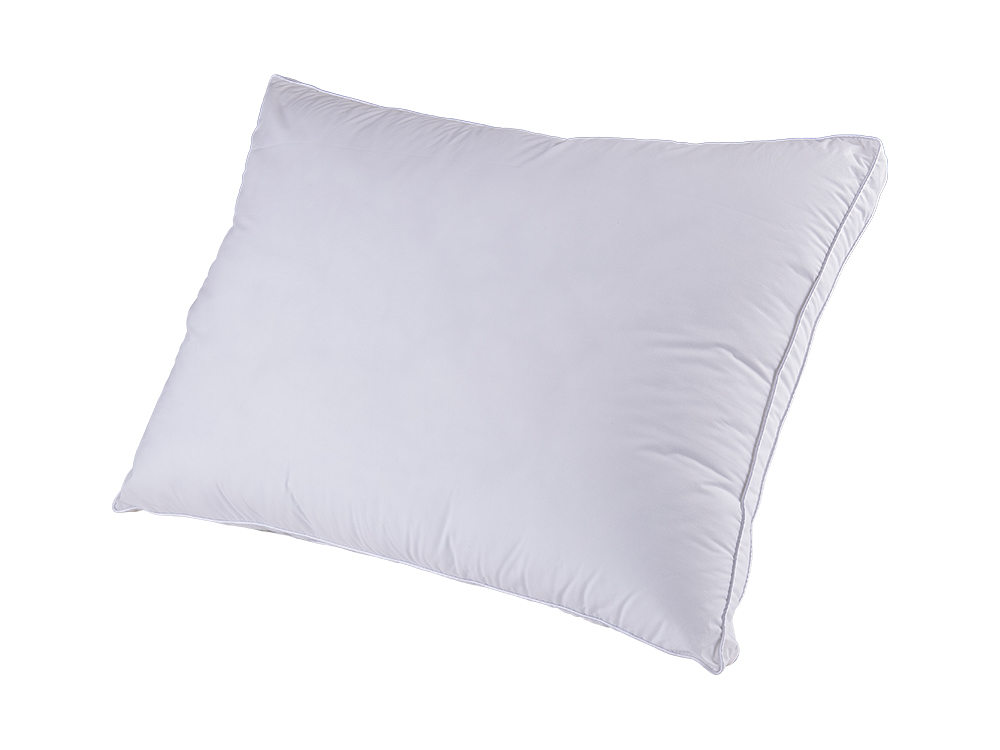
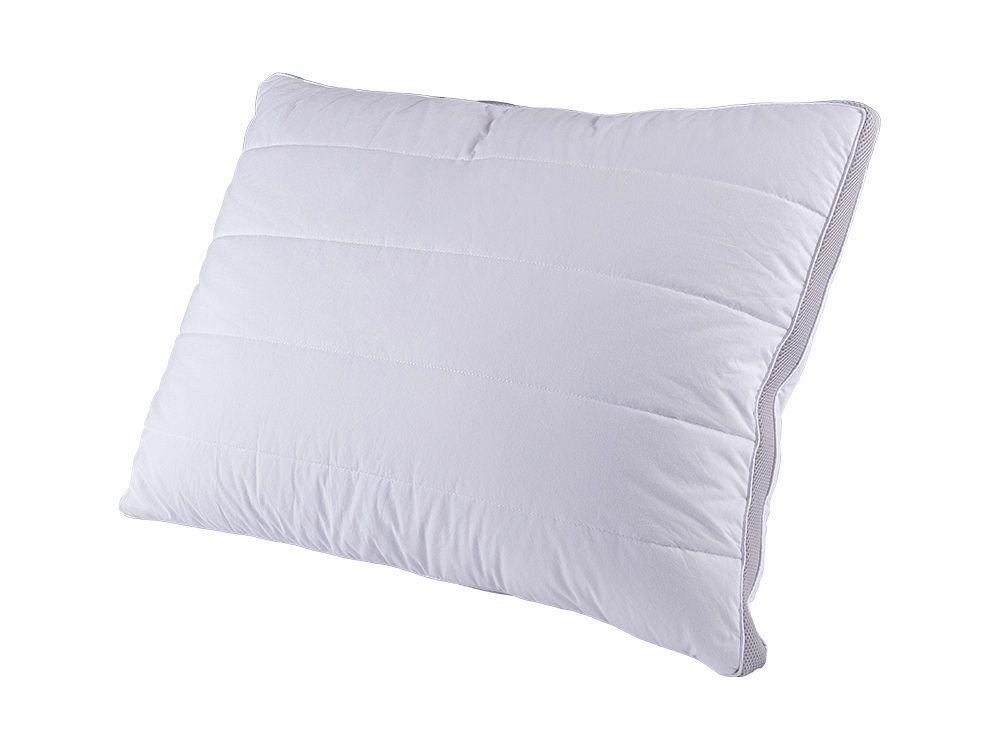
A pillow is one of the most important textile products in any bedroom, guest room, hotel, dormitory, or relaxation area. Although it may appear simple, a high-quality pillow requires careful decisions about fabric selection, filling performance, quilting construction, dimensional stability, finishing, and quality control. The Short Plush Quilted Pillow combines these essential elements in one versatile product. Designed with a soft short velvet front, a practical brushed fabric back, a fluffy 6D polyester filling, and a contemporary quilted surface, it provides both everyday sleeping comfort and decorative value.
With its 60x80cm size, the pillow offers generous coverage while remaining easy to place on a bed, sofa, armchair, daybed, or lounge area. Its appearance is suitable for modern home textile collections, while its polyester construction supports efficient production, practical maintenance, and broad market application. It can function as a sleeping pillow, a decorative pillow, or a comfortable cushion, giving retailers and hospitality buyers more flexibility when developing product assortments.
The product is manufactured by Tongxiang Xinlong Bedding Co., Ltd., an established home textile producer located in Wuzhen, Tongxiang, Zhejiang Province, China. Since its establishment in January 2002, the company has developed experience in quilts, pillows, cushions, mattress protectors, blankets, mattress covers, bedspreads, pillowcases, curtains, shower curtains, and related household textile products. Its production capabilities, technical personnel, equipment resources, quality systems, and experience in customized home bedding provide a strong foundation for manufacturing products such as the Short Plush Quilted Pillow.
This article examines the product’s construction, design benefits, functional advantages, manufacturing considerations, quality strengths, commercial applications, and purchasing value. It also explains why the combination of short plush fabric, brushed fabric, quilted construction, and 6D polyester filling can offer a competitive alternative to basic pillows with plain surfaces or less carefully selected materials.
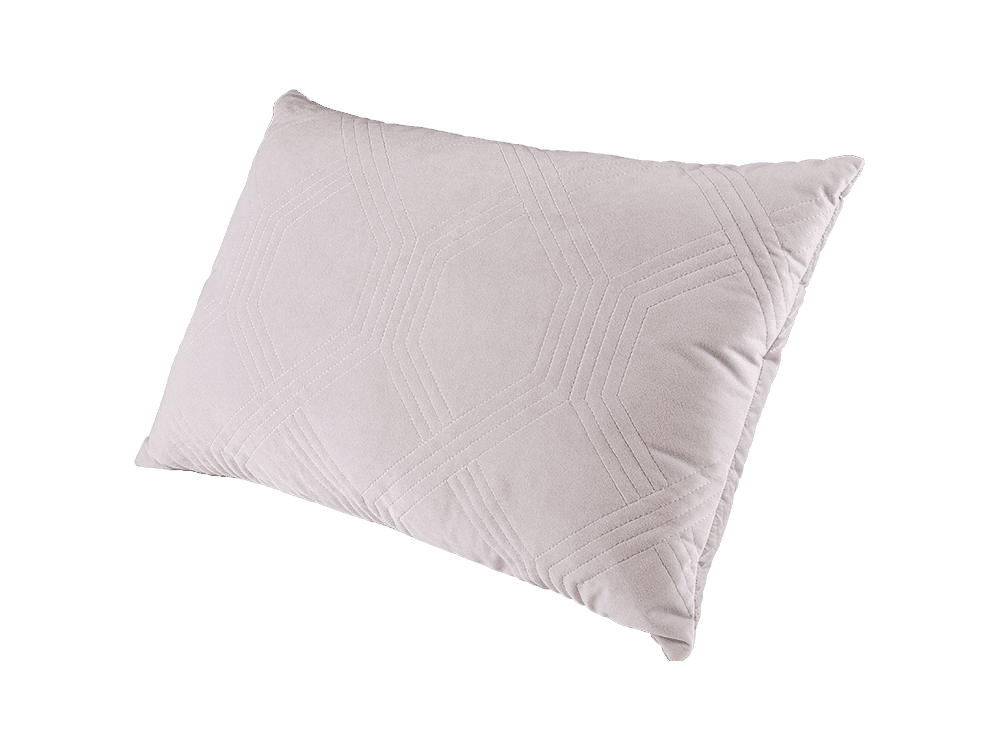
Short Plush Quilted Pillow
1. Product Overview
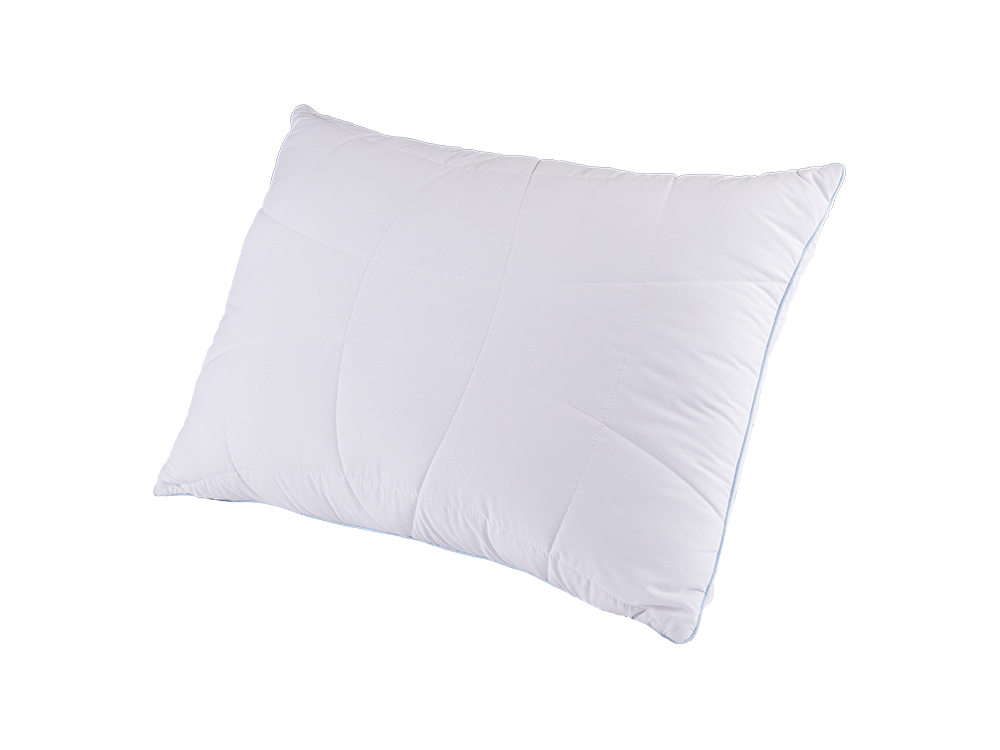
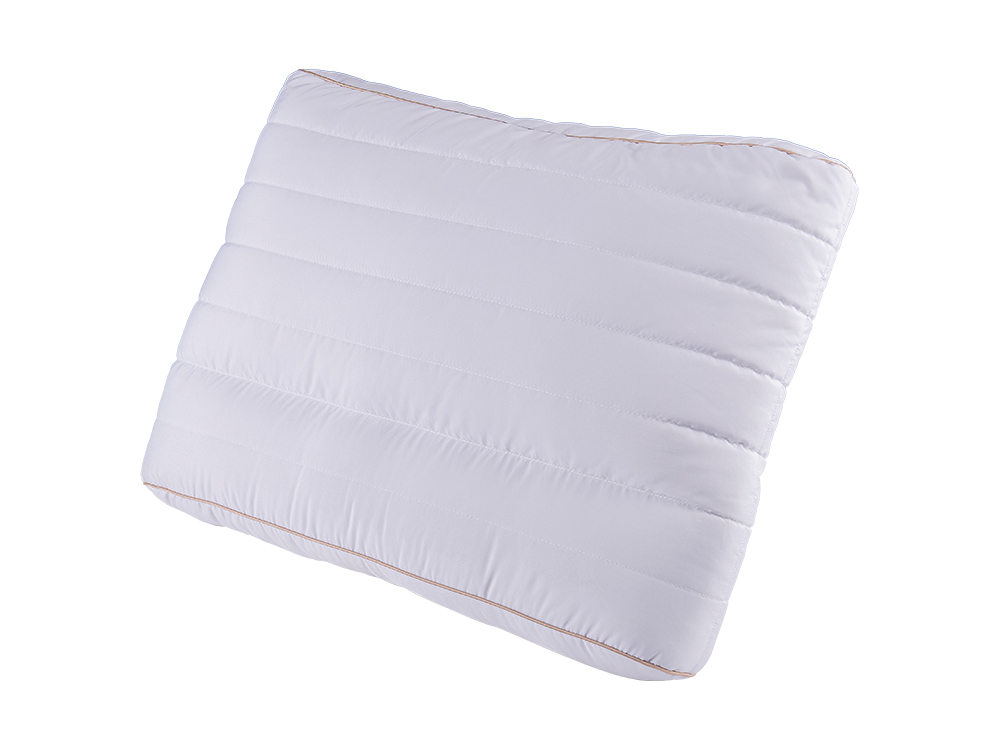
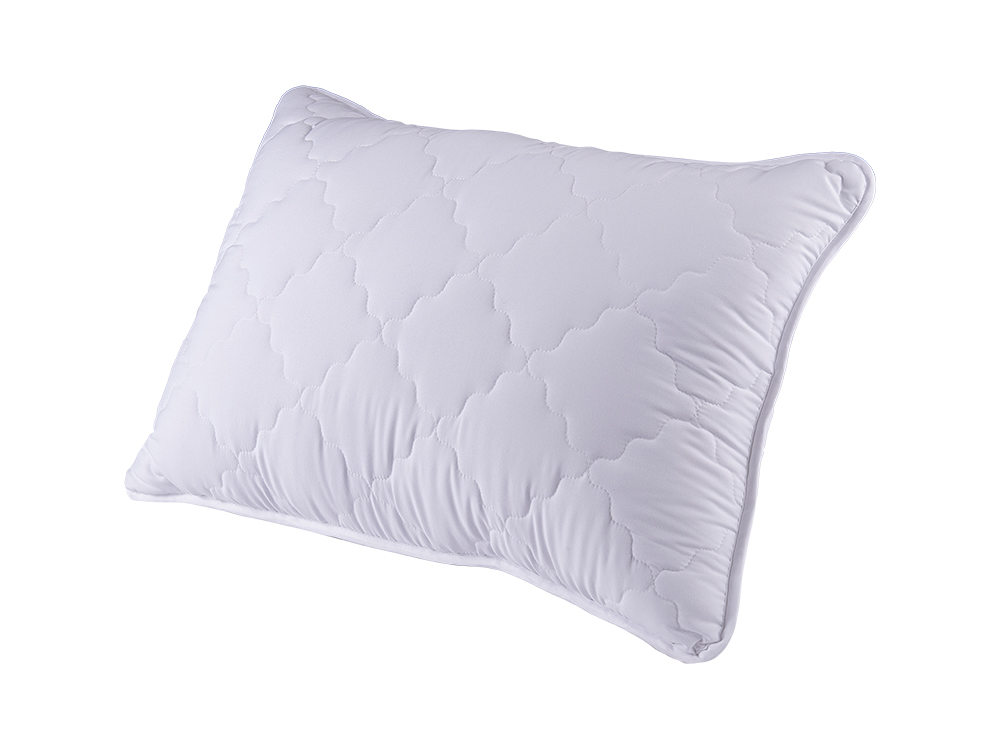
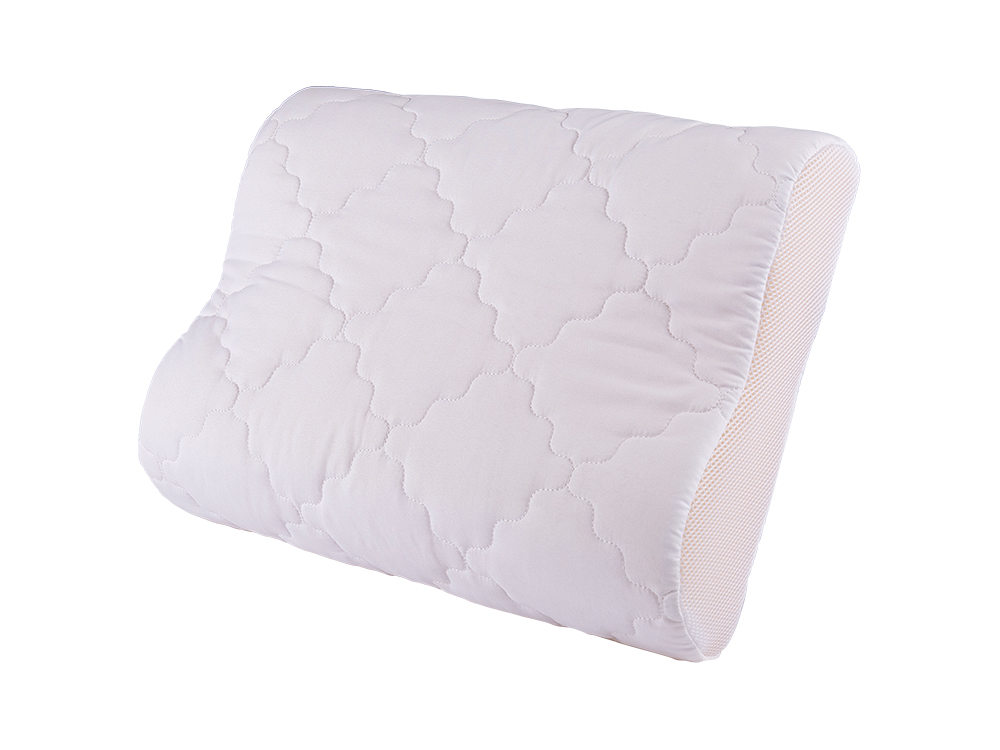
The Short Plush Quilted Pillow is a polyester pillow measuring 60x80cm. Its front side uses short velvet fabric, while the back side uses 90gsm brushed fabric. The interior is filled with 6D polyester fiber. A quilted pattern is applied to the outer surface, creating a visually attractive structure while helping the pillow maintain a consistent and coordinated appearance.
The front short velvet material is selected for its soft hand feel and smooth surface. Short velvet has a dense, low-pile appearance that can create a refined visual effect without the excessive bulk of long-pile plush materials. The surface reflects light gently, giving the product a subtle texture and a more premium appearance than a basic flat woven pillow.
The rear brushed fabric contributes a practical and comfortable finishing layer. Brushed fabrics are processed to raise fine fibers on the surface, creating a soft touch and a warm textile feel. The use of 90gsm brushed fabric on the back balances comfort with material efficiency. This construction makes the pillow pleasant to handle from either side while maintaining a differentiated front and back design.
The 6D polyester filling provides loft and softness. Polyester fiber is widely used in bedding because it can be formed into lightweight, resilient filling structures suitable for pillows and cushions. The 6D specification indicates a fiber fineness classification, while the fiber configuration contributes to a fuller, more elastic feel. In daily use, the filling supports a soft and fluffy profile that is appropriate for relaxation, decorative styling, and general pillow applications.
The quilted pattern is an important feature rather than a purely decorative detail. Quilting visually organizes the surface and can help connect the outer shell with the inner filling. A carefully produced quilted structure may reduce excessive movement between fabric layers, support a more stable appearance, and make the pillow look more finished. It also gives the product an identifiable design language that can distinguish it from ordinary plain polyester pillows.
Product name |
Short Plush Quilted Pillow |
Product category |
Polyester Pillow |
Recommended size |
60x80cm |
Front fabric |
Short velvet fabric |
Back fabric |
90gsm brushed fabric |
Filling |
6D polyester |
Primary uses |
Pillow, cushion, decorative bedding, guest-room accessory |
Manufacturing company |
Tongxiang Xinlong Bedding Co., Ltd. |
2. The Advantages of Short Velvet Fabric
2.1 A Soft and Smooth Hand Feel
The first advantage of short velvet fabric is its tactile quality. A pillow is frequently touched, adjusted, hugged, and moved, so the hand feel of the outer cover has a direct effect on perceived product value. Short velvet provides a smooth, gentle surface that feels comfortable against the hands and face. Compared with many coarse or ordinary woven fabrics, it creates a more pleasant first impression.
Softness is especially important for products positioned in the comfort and home decoration markets. Customers often evaluate bedding through sensory experience before considering technical details. When a pillow feels soft and substantial, it can communicate comfort, care, and quality. The Short Plush Quilted Pillow uses this tactile advantage to create a product that is not only functional but also emotionally appealing.
2.2 A Refined Visual Texture
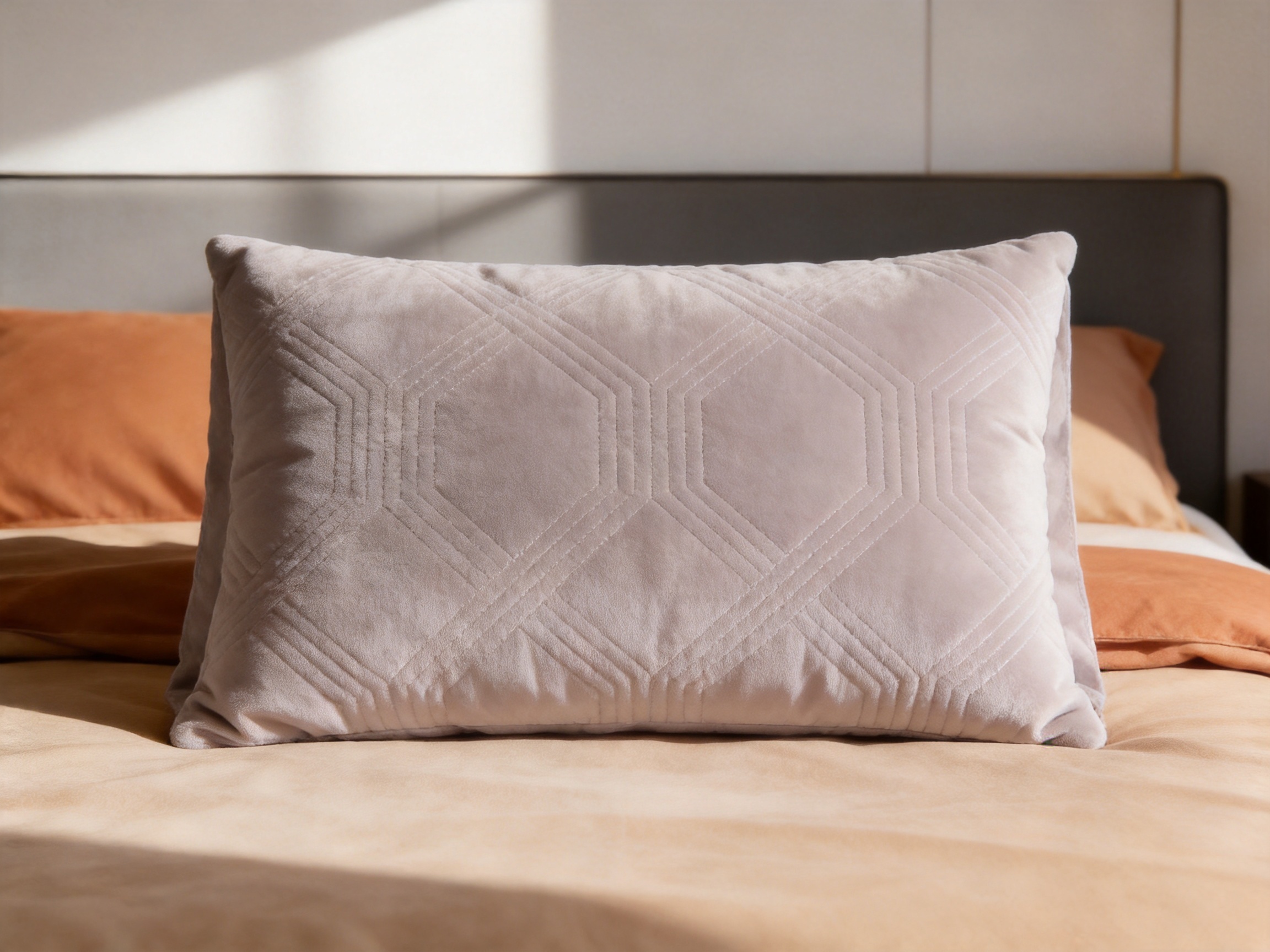
Short velvet also offers a distinctive appearance. The fine pile creates a controlled surface texture that can appear different under changing light conditions. This gives the pillow more visual depth than a completely flat fabric. The result is a sophisticated look that can complement contemporary, transitional, minimalist, or cozy interior styles.
Many low-cost pillows rely on plain fabric and simple stitching. While such products may fulfill a basic need, they can appear ordinary when displayed in a retail environment or used as part of a coordinated bedding collection. The short velvet surface of this pillow creates a stronger visual identity. It can help retailers present the item as a style-oriented home textile rather than only as a basic sleeping accessory.
2.3 Suitable for Decorative Applications
The short-pile structure is also suitable for decorative use because it adds texture without overwhelming surrounding furnishings. Long-pile fabrics may create a highly pronounced or informal appearance, while flat fabrics may lack visual interest. Short velvet occupies a practical middle position: it is visibly plush, but still neat and controlled.
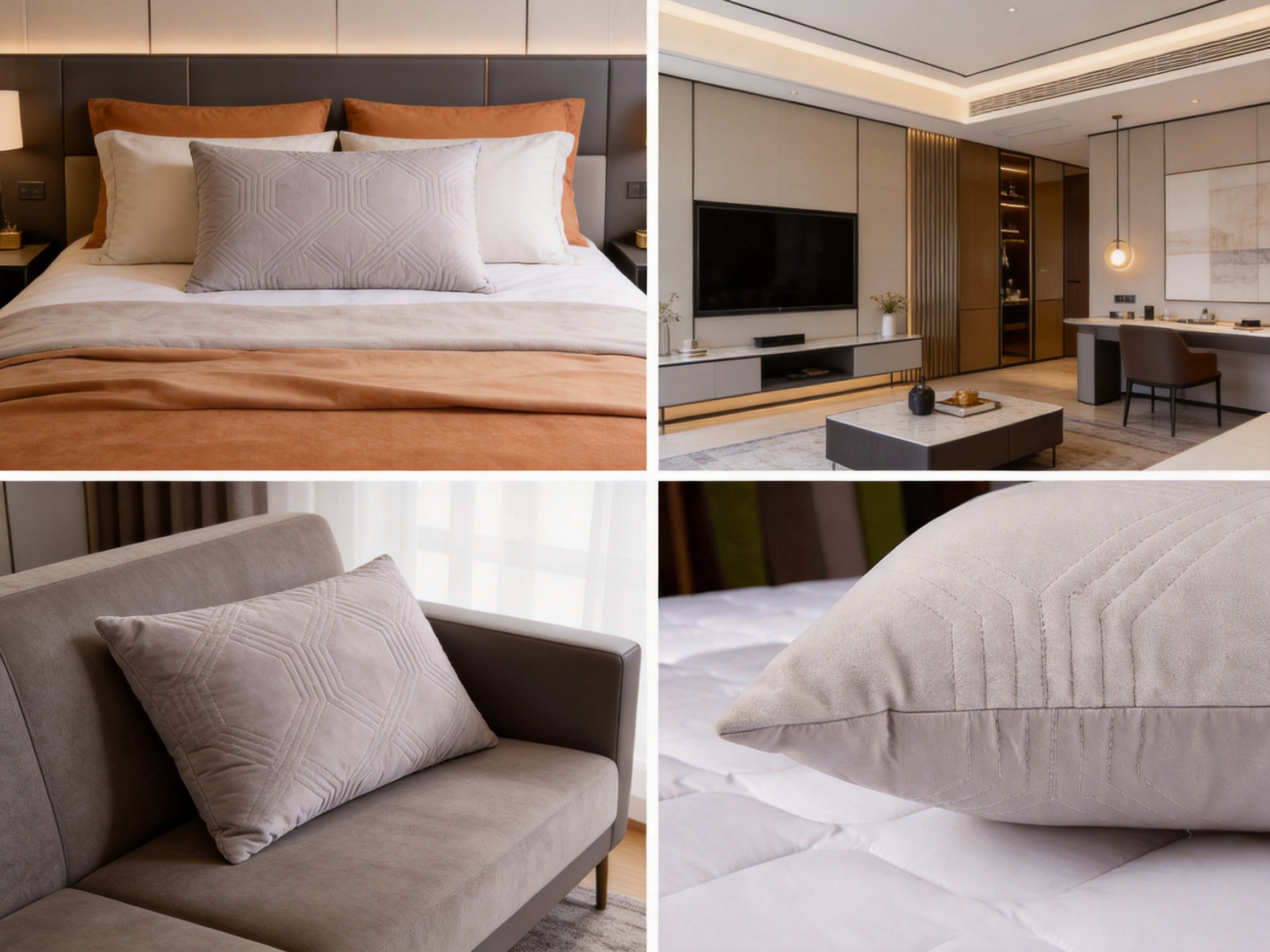
This makes the pillow suitable for layered bedding displays, sofa arrangements, reading corners, guest rooms, lounge areas, and hospitality interiors. It can be used individually or combined with quilts, blankets, mattress covers, and other cushions. For buyers building a complete home textile range, the pillow offers a way to introduce surface variety while maintaining a coordinated and practical product profile.
3. The Functional Role of the Brushed Fabric Back
The back of the pillow uses 90gsm brushed fabric, creating a complementary surface to the short velvet front. This two-sided construction improves the product’s versatility. Users can place either side outward according to preference, styling requirements, or the desired tactile experience.
Brushed fabric has a soft raised surface created through a mechanical finishing process. The fine fibers provide a warm and comfortable touch, which is appropriate for bedding products used in bedrooms and relaxation spaces. The brushed back can also reduce the cold or overly smooth feeling associated with some conventional synthetic fabrics.
The difference between the front and back fabrics provides design flexibility. The velvet side can be used as the display surface when a more luxurious or decorative appearance is desired. The brushed side can be selected when a simpler, softer, or more understated appearance is preferred. This effectively gives one product two complementary visual and tactile identities.
Using a defined 90gsm fabric specification also helps create a clearer manufacturing standard. Fabric weight is one factor that influences hand feel, drape, coverage, and product consistency. A specified back fabric allows the manufacturer and buyer to communicate more accurately during sourcing and production. It supports more consistent results across production batches than an undefined description such as “soft backing fabric.”
Compared with pillows using only one basic fabric on both sides, the two-fabric design may provide greater differentiation. It can enhance the perceived quality of the item and make the product more suitable for customers who value both appearance and comfort. The construction also supports merchandising strategies in which a single pillow is presented as reversible or multi-purpose, subject to the final care and labeling instructions determined for the product.
4. 6D Polyester Filling and Comfort Performance
4.1 Lightweight Loft
The interior of the Short Plush Quilted Pillow is filled with 6D polyester. Polyester filling is widely used in bedding because it can produce a soft, lightweight, and resilient structure. The fibers create air spaces within the pillow, helping it maintain a fluffy appearance without making it excessively heavy.
For a pillow that can also be used as a cushion, lightweight construction is a practical benefit. Users can move it easily from the bed to a sofa or from one room to another. Retailers and hospitality operators also benefit from manageable product weight during storage, packing, display, and transportation.
4.2 A Fluffy and Comfortable Profile
The filling is designed to create a full, soft profile. This is important because the visual fullness of a pillow strongly affects customer expectations. A pillow that appears flat or underfilled may be perceived as less comfortable, even before use. A well-distributed polyester filling allows the product to appear more substantial and welcoming.
The filling also supports the pillow’s use as a cushion. When placed behind the back, beneath the arms, or beside the body, a fluffy fiber-filled construction can provide a comfortable layer of support. It is not presented as a specialized orthopedic pillow, but its soft construction makes it suitable for general comfort and decorative purposes.
4.3 Practicality for Commercial Production
Polyester filling is also advantageous from a manufacturing perspective. It is a familiar material for bedding factories, allowing manufacturers to develop established handling, filling, sewing, and finishing procedures. Polyester can support efficient production planning and consistent product assembly when appropriate equipment and quality controls are used.
Compared with some natural fillings, polyester can provide more predictable sourcing and production characteristics for large-volume home textile programs. It also gives buyers a broadly accepted material option for mainstream retail, hospitality, and private-label collections. The choice of polyester therefore supports both product usability and commercial scalability.
5. Quilted Construction and Product Appearance
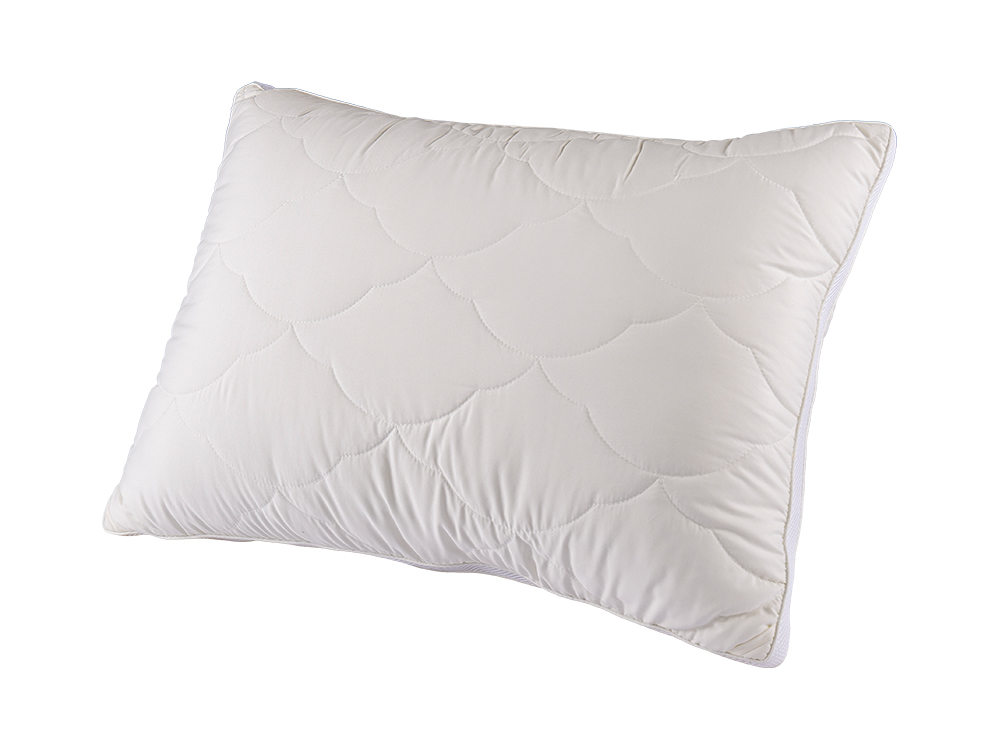
The quilted pattern is one of the most visible design features of the product. Quilting transforms a simple pillow shell into a structured textile surface. The pattern adds rhythm, depth, and a more carefully designed appearance. It can coordinate effectively with bedding collections that use stitched lines, geometric forms, grids, diamonds, or other decorative motifs.
A quilted pillow may also have a more stable visual relationship between its cover and filling. The stitching creates organized connection points across the surface, which can help limit excessive shifting of the filling within the shell. The specific performance of the quilting depends on stitch density, pattern geometry, seam construction, filling distribution, and production quality. Nevertheless, the general principle is valuable: a controlled stitched structure can contribute to a neater and more consistent finished product.
From a design perspective, quilting provides a competitive advantage over plain pillows. Retail shelves and online product pages are highly visual environments. Customers often compare several similar products at a glance. A quilted surface creates an immediate point of distinction and can make the pillow appear more fashionable, substantial, and suitable for coordinated interiors.
The quilted pattern also gives buyers more opportunities for product positioning. The pillow can be promoted as part of a modern bedding group, a decorative bedroom collection, a seasonal soft-furnishing line, or a comfort-focused home accessory. Because the pattern is integrated into the textile construction, it does not depend entirely on printed graphics that may provide a different visual effect or require additional printing processes.
6. Competitive Advantages Compared with Basic Polyester Pillows
The Short Plush Quilted Pillow competes in a broad market that includes plain polyester pillows, cotton-covered pillows, printed cushions, long-pile plush cushions, and premium natural-filled products. Its strongest position is the balance between decorative appearance, soft comfort, practical materials, and manufacturing feasibility.
6.1 More Distinctive Than Plain Pillow Designs
Basic polyester pillows often use a single smooth fabric and a simple rectangular construction. These products may be affordable, but their appearance can be limited. The Short Plush Quilted Pillow adds value through its short velvet front, contrasting brushed back, and quilted surface. These features create a more developed design without requiring an overly complicated product concept.
6.2 Softer and More Textured Than Ordinary Woven Covers
Ordinary woven covers may be durable and economical, but they do not always provide the same soft and plush hand feel. The short velvet face gives this pillow a more inviting surface. It is particularly suitable for buyers seeking a product that combines everyday utility with a premium tactile impression.
6.3 More Controlled Than Excessively Long Plush Materials
Long-pile plush fabrics can be attractive, but they may be harder to coordinate with certain interior styles and can create a more informal visual effect. Short velvet offers a cleaner silhouette and controlled texture. It provides softness and visual richness while remaining suitable for modern bedding displays and refined home decoration.
6.4 More Versatile Than Single-Purpose Sleeping Pillows
Some sleeping pillows are designed only for use beneath the head. The Short Plush Quilted Pillow has a wider lifestyle application. Its generous size, decorative quilting, and full polyester filling allow it to be used as a sleeping pillow, back cushion, decorative pillow, or general comfort accessory. This versatility can increase its value for both consumers and commercial buyers.
6.5 A Practical Alternative to More Costly Specialty Fillings
Natural down, feather, latex, and memory foam products occupy different market segments and may provide specialized performance characteristics. However, they can also involve higher material costs, different care requirements, or more complex sourcing considerations. A 6D polyester pillow offers a practical alternative for buyers who want softness and fullness in a broadly accessible material category.
Comparison factor |
Short Plush Quilted Pillow |
Basic plain polyester pillow |
Surface design |
Short velvet front with quilted pattern |
Usually plain or minimally textured |
Back construction |
90gsm brushed fabric |
Often the same basic fabric as the front |
Filling |
6D polyester with a fluffy profile |
General polyester filling may vary |
Primary positioning |
Comfort, decoration, and versatile use |
Basic sleeping or decorative function |
Visual differentiation |
High, due to texture and quilting |
Moderate to low |
Application range |
Bedroom, sofa, guest room, hospitality, retail |
Generally focused on basic bedding use |
7. Manufacturing Capabilities Behind the Product
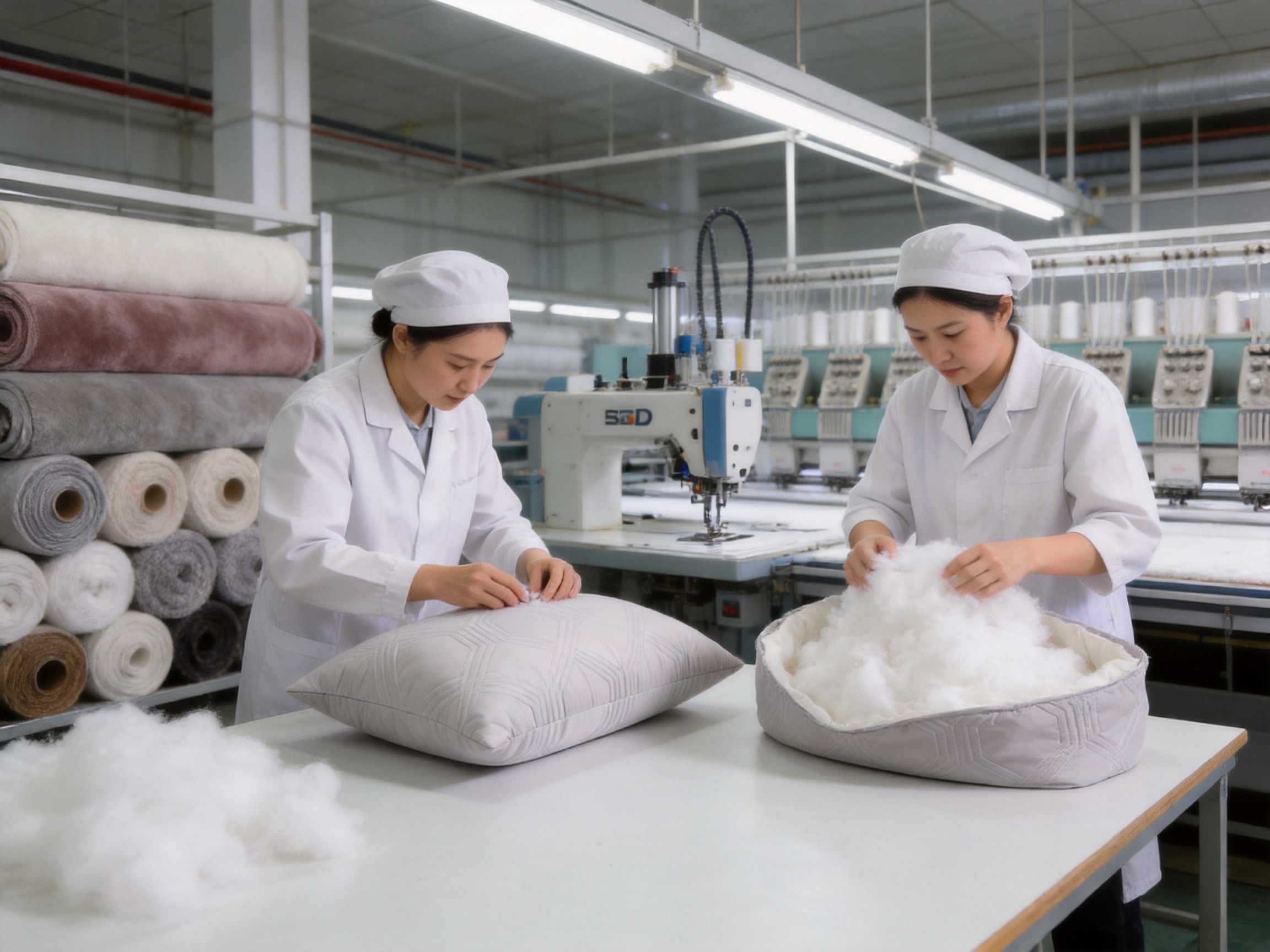
The quality of a finished pillow depends not only on its listed materials but also on how those materials are processed and assembled. Tongxiang Xinlong Bedding Co., Ltd. has operated in the home textile industry since January 2002. Its long-term experience provides a foundation for understanding different textile structures, filling types, bedding applications, and customer requirements.
The company is located in Longxiang Industrial Park, Wuzhen Town, Tongxiang, Zhejiang Province, China. It covers approximately 21,000 square meters, with a construction area of approximately 18,000 square meters, and has more than 320 employees. This scale supports the organization of production, technical management, quality supervision, material handling, and order coordination.
The company produces a wide range of home textile products, including silk cotton quilts, chemical fiber quilts, pillows, cushions, bedspreads, travel quilts, mattress protectors, blankets, quilt and pillowcases, shower curtains, and curtains. This broad product scope is relevant to pillow manufacturing because it provides experience across many related processes. Pillow production can benefit from knowledge developed through quilt filling, cover sewing, mattress protector construction, blanket finishing, and other textile operations.
A diverse product portfolio can also support better understanding of complete bedding systems. A pillow may be sold independently, but it may also be developed as part of a coordinated assortment that includes quilts, blankets, mattress covers, cushions, and protective bedding. A manufacturer familiar with these categories is better positioned to consider fabric coordination, product proportions, packaging programs, and collection-level consistency.
7.1 Material Preparation
Material preparation is an important stage in manufacturing. The selected short velvet fabric and brushed fabric must be checked for appearance, width, color consistency, surface defects, and suitability for cutting. Polyester filling must be handled in a way that supports even distribution and the desired finished loft.
Careful preparation helps reduce inconsistencies before sewing begins. Fabric rolls may contain variations in shade, texture, or surface direction, so organized inspection and cutting procedures are essential. For a plush or brushed material, the direction of the pile can affect the way light reflects from the surface. Consistent orientation helps maintain a uniform appearance across the product.
7.2 Cutting and Panel Formation
The front and back fabrics must be cut according to the intended 60x80cm finished size, seam allowance, quilting pattern, and production tolerances. Accurate cutting supports dimensional consistency and helps prevent uneven edges or distorted proportions.
During panel formation, the manufacturer must also consider the relationship between the outer shell and inner filling. A pillow that is cut too tightly may compress the filling, while a shell that is too loose may appear uneven. Balanced pattern dimensions and controlled assembly contribute to a fuller and more attractive result.
7.3 Quilting Process
The quilting process connects the outer fabric layers with the filling or an intermediate structure, depending on the production method. The quilted pattern must be aligned correctly and stitched consistently. Uneven stitching can affect the visual appeal of the pillow and may create unwanted tension on the fabric.
Professional quilting requires appropriate machine settings, stable fabric feeding, suitable thread selection, and trained operators. The short velvet surface must be handled carefully to preserve its appearance. The brushed backing also requires controlled processing so that the raised surface remains attractive and does not become excessively compressed or damaged during production.
7.4 Filling and Closing
After the shell components are prepared, 6D polyester filling is inserted and distributed. Filling quantity and distribution have a direct influence on the pillow’s loft, softness, weight, and shape. The objective is to achieve a full but comfortable profile rather than an uneven product with empty areas or excessive hard spots.
The closing seam must be secure and neat. It should contain the filling during normal handling and use while maintaining a clean appearance. Seam quality is especially important for pillows because the product is frequently compressed, moved, and reshaped. A properly closed shell supports durability and customer confidence.
7.5 Finishing and Inspection
Final finishing may include thread trimming, surface cleaning, shape adjustment, measurement checks, appearance inspection, labeling, folding, and packaging. The pillow should be reviewed from both sides because it uses two different fabrics. Inspectors can check the short velvet surface for visible flaws, the brushed back for irregularities, and the quilted pattern for alignment and continuity.
Dimensional checks help verify that the product remains close to the specified 60x80cm size. Appearance checks can identify loose threads, incomplete stitching, fabric damage, uneven filling, or surface marks. These steps are particularly important when the product is intended for export, private-label sales, hospitality projects, or coordinated bedding collections.
8. Quality Management and Certifications
The company states that it has passed international certifications and standards including ISO 9001, ISO 14001, OEKO-TEX-related standards, OEKO-STEP, GRS, and BSCI. These certifications and assessments reflect attention to quality management, environmental management, material responsibility, social compliance, and standardized business operations. The exact scope and validity of any certification should be confirmed for the relevant order and production period, but the company’s certification framework demonstrates a commitment to formalized management.
ISO 9001 is associated with quality management systems. In a home textile factory, a structured quality management approach can support documented procedures, process monitoring, corrective actions, traceability, and continual improvement. For a pillow manufacturer, this may be relevant to fabric inspection, filling control, sewing standards, in-process checks, and final product evaluation.
ISO 14001 is associated with environmental management systems. Textile production involves fabric, filling, packaging, energy, water, and waste considerations. An environmental management framework can help a factory identify impacts, improve operational controls, and establish more systematic environmental objectives.
OEKO-TEX-related standards are commonly associated with testing textiles for certain harmful substances. For bedding products that come into close contact with the body, material safety is an important purchasing consideration. Buyers should request current documentation and verify the applicable product scope, but the company’s reference to these standards indicates attention to textile safety requirements.
GRS is associated with recycled material claims and chain-of-custody requirements where applicable. Not every product is necessarily made with recycled content, so buyers should confirm whether a specific pillow, fabric, filling, or packaging component falls within the relevant certification scope. The presence of GRS capability may nevertheless be valuable for customers developing sustainability-oriented product lines.
BSCI is associated with social compliance assessment. Responsible working conditions, ethical employment practices, and supply chain transparency are increasingly important to international home textile buyers. A factory that participates in recognized social compliance systems may be better prepared to meet the documentation and audit expectations of global customers.
The company also reports that it has been rated as a safety production standardization enterprise for several consecutive years since 2016. Workplace safety is relevant to production continuity, employee welfare, equipment management, and operational reliability. A safe and organized factory environment can support more stable manufacturing performance.
9. Custom Home Bedding and Buyer Support
Home textile buyers often require more than a standard product. They may need specific colors, packaging formats, labels, dimensions, patterns, fabric combinations, or order quantities. A manufacturer with experience in custom home bedding can help transform a general product concept into a commercially suitable collection.
The Short Plush Quilted Pillow can serve as a development starting point for different market programs. Buyers may evaluate the standard construction first and then discuss possible adjustments based on their target customers. Potential areas for development may include color selection, quilted pattern variation, fabric shade matching, packaging presentation, private labels, and coordinated items.
Customization must be approached systematically. Any change to the fabric, filling, size, quilting pattern, or packaging can affect cost, production time, appearance, and performance. A professional manufacturer should review the technical requirements, prepare samples where appropriate, confirm specifications, and establish approval procedures before mass production.
The company’s broader product range may also support collection development. A buyer sourcing the pillow may be able to coordinate it with a quilt, blanket, mattress protector, mattress cover, cushion, or bedspread. This can simplify vendor management and help create a consistent product story across multiple categories.
10. Applications in Different Markets
10.1 Residential Bedrooms
In residential bedrooms, the pillow can be used as a functional sleeping accessory or as part of a layered decorative arrangement. Its 60x80cm size provides substantial coverage, while the quilted short velvet face adds visual interest to the bed. It can be placed behind smaller decorative cushions or used as a large accent pillow.
10.2 Sofas and Living Rooms
The product can also function as a cushion in living rooms. The fluffy filling makes it suitable for back support, arm support, or relaxed seating. Its soft textile surface complements fabric sofas, upholstered chairs, benches, and daybeds. The reversible front and back construction gives users additional styling flexibility.
10.3 Guest Rooms
Guest rooms benefit from products that are attractive, comfortable, and easy to integrate into existing bedding schemes. The pillow’s neutral construction concept can be adapted to different color palettes and interior styles. It may be used as an extra comfort pillow or as a decorative layer that makes the room appear more welcoming.
10.4 Hotels and Hospitality Interiors
Hospitality buyers often seek bedding accessories that combine presentation quality with practical production. A quilted pillow can contribute to room styling, lounge areas, suites, serviced apartments, and other guest environments. Before commercial use, buyers should define applicable specifications for cleaning, care, packaging, labeling, and replacement programs.
10.5 Retail and E-Commerce
For retailers and online sellers, visual differentiation is important. The short velvet texture and quilted appearance can be communicated effectively through product photography and in-store merchandising. The pillow’s dual function as a pillow and cushion also supports broader product descriptions and multiple merchandising contexts.
10.6 Seasonal and Gift Collections
Soft, plush, and quilted home textiles are often suitable for seasonal collections, comfort-themed promotions, and home gift assortments. The product can be positioned around relaxation, warmth, bedroom refreshes, housewarming, or interior decoration. Its material combination allows the item to appear more decorative than a conventional utility pillow.
11. Packaging, Handling, and Product Presentation
Packaging should protect the short velvet surface, preserve the pillow’s shape as much as possible, and present the product clearly to the buyer. Because plush and brushed fabrics can collect dust or show pressure marks, packaging materials and handling procedures should be selected carefully.
Depending on the sales channel, the pillow may be packed individually or grouped with other bedding products. Retail packaging can include product information, material composition, size, care instructions, and usage guidance. Hospitality and wholesale orders may require bulk cartons, internal protective layers, palletization, and shipping marks.
Compression may be considered for transportation efficiency, but buyers should evaluate how compression affects the recovery of the 6D polyester filling and the appearance of the velvet surface. A recovery test after unpacking can help determine whether the selected packing method is appropriate. The final packaging design should balance logistics efficiency with customer presentation.
For online sales, high-quality images should show the front surface, back fabric, quilted pattern, overall dimensions, and product thickness. Clear photography helps customers understand the difference between short velvet and ordinary fabric. Accurate descriptions should avoid unsupported performance claims and should explain that the item is intended as a soft pillow or cushion rather than a specialized medical or ergonomic device.
12. Care and Use Considerations
Care instructions should be confirmed according to the final fabric, filling, stitching, labeling, and testing requirements. Polyester-based products are often selected for their practical care characteristics, but the appropriate washing, drying, and cleaning method depends on the complete product construction.
Users should follow the care label supplied with the finished item. Regular airing and gentle handling can help maintain freshness and shape. If the product becomes compressed during storage or transport, gentle shaking and careful reshaping may help restore its loft. Excessive heat, unsuitable chemicals, or rough mechanical treatment may affect the velvet surface, brushed backing, stitching, or filling.
As with all bedding products, the pillow should be kept clean and dry. Buyers supplying the product to hotels, rental properties, or institutional settings should establish appropriate cleaning and replacement procedures. Commercial users may also require additional testing or documentation according to their market regulations and internal standards.
13. Why Manufacturing Experience Matters
A product specification is only valuable when it can be reproduced consistently. The same listed materials may produce very different results depending on fabric inspection, cutting accuracy, quilting control, filling distribution, sewing quality, and final inspection. Manufacturing experience is therefore a major factor when selecting a home textile supplier.
Tongxiang Xinlong Bedding Co., Ltd. has more than two decades of industry history, beginning in January 2002. Its continued operation reflects experience in a competitive home textile environment. The company’s focus on quality, technical development, employee training, and product innovation supports the production of bedding items that need to meet both aesthetic and functional expectations.
The company’s reported workforce of more than 320 employees and its factory area provide the organizational scale needed for coordinated production. Advanced production equipment can improve efficiency and repeatability, while professional technical staff can help manage product development and process adjustments. These resources are particularly important for quilted products, where fabric handling and stitching precision affect the finished appearance.
Experience across different categories can also help the manufacturer identify practical production risks. For example, knowledge of quilt construction may support better filling distribution, while experience with mattress protectors may strengthen understanding of edge finishing and textile durability. Experience with blankets and cushions may contribute to improved fabric handling and packaging methods.
14. Responsible and Continuous Development
The home textile industry changes continuously as customers seek new textures, improved comfort, attractive designs, safer materials, and more responsible production. Manufacturers must respond through product development, process improvement, equipment investment, technical training, and quality management.
The company states that it continues to develop and innovate in order to adapt to changing home textile requirements. This approach is relevant to the Short Plush Quilted Pillow because the product combines several market trends: tactile fabrics, quilted decoration, multifunctional use, polyester comfort, and coordinated home styling.
Continuous improvement does not necessarily mean making every product more complicated. In many cases, it means refining the balance between design and manufacturability. The Short Plush Quilted Pillow demonstrates a relatively straightforward product concept enhanced through thoughtful material pairing and surface construction. This balance can help keep the product commercially accessible while giving it more identity than a basic pillow.
15. Buyer Evaluation Checklist
Before placing an order, buyers should confirm the complete technical specification. Important points include the finished size, fabric composition, fabric weight, color standard, pile direction, filling specification, filling weight, quilting pattern, stitching requirements, seam tolerance, labeling, packaging, and care instructions.
Sample approval is recommended for buyers developing a new collection. A physical sample can help confirm softness, loft, surface appearance, color, dimensions, quilting alignment, and overall product balance. Buyers should compare the approved sample with pre-production and production goods through documented inspection procedures.
It is also useful to confirm the intended application. A pillow designed for retail home use may have different packaging and labeling requirements from one intended for hotel rooms, promotional programs, or institutional supply. Market-specific testing, regulatory review, and certification documentation should be addressed before shipment where necessary.
Evaluation area |
Points to confirm |
Materials |
Short velvet front, 90gsm brushed back, 6D polyester filling |
Dimensions |
Finished size of 60x80cm and acceptable tolerance |
Appearance |
Color, surface uniformity, pile direction, quilting alignment |
Construction |
Seam strength, edge finishing, filling distribution, shape recovery |
Documentation |
Material details, care instructions, test reports, certification scope |
Packaging |
Individual or bulk packing, carton requirements, shipping marks |
Commercial requirements |
Minimum order quantity, lead time, sample approval, private labeling |
16. Frequently Asked Questions
What is the main material used in the Short Plush Quilted Pillow?
The pillow uses short velvet fabric on the front, 90gsm brushed fabric on the back, and 6D polyester filling inside. This combination provides a soft surface, a comfortable reverse side, and a fluffy synthetic filling.
What size is the pillow?
The listed size is 60x80cm. Buyers should confirm the finished measurement tolerance and whether the measurement is taken before or after filling and quilting when finalizing a production specification.
Can the product be used as a cushion?
Yes. The product is designed to function as both a pillow and a cushion. Its fluffy filling and decorative quilted surface make it suitable for beds, sofas, armchairs, daybeds, and other relaxation areas.
What makes short velvet different from ordinary fabric?
Short velvet has a fine, low-pile surface that feels soft and smooth and provides a subtle plush appearance. It can offer more tactile and visual richness than a basic flat woven cover while maintaining a relatively neat profile.
Why is the back made from brushed fabric?
The brushed fabric back provides another soft surface and creates a two-sided construction. It complements the short velvet front and gives users more flexibility in handling and display.
What does 6D polyester mean?
Six-denier, or 6D, refers to a fiber fineness classification. In this product, 6D polyester is used as a fluffy filling material intended to provide lightweight volume and softness. The final comfort level also depends on the filling quantity, distribution, shell construction, and quilting.
Does the quilting improve the product?
Quilting enhances the appearance by adding a structured pattern and can help maintain a more organized relationship between the textile layers and filling. Actual performance depends on the specific quilting design, stitching quality, and production process.
Is this an orthopedic or medical pillow?
No. The product is a general soft polyester pillow and cushion. It is not presented as a medical, orthopedic, cervical, or therapeutic support product.
Can the pillow be customized?
Customization should be discussed with the manufacturer. Possible development areas may include colors, dimensions, quilting patterns, labels, packaging, and coordination with other home textile products. Any changes should be confirmed through samples and written specifications.
What kinds of buyers may be interested in this product?
Potential buyers include home textile wholesalers, retailers, e-commerce brands, hotel suppliers, interior furnishing companies, private-label brands, furniture stores, and distributors seeking soft decorative bedding products.
What quality information should buyers request?
Buyers should request the relevant material specifications, sample details, inspection standards, care information, packaging requirements, and current certification or test documentation applicable to the order. The scope and validity of any certification should be verified for the specific product and production period.
How does the manufacturer support product reliability?
The manufacturer has operated since 2002, maintains a substantial production site and workforce, produces multiple categories of home textiles, and reports certifications and safety standardization experience. These factors provide a foundation for organized production, but buyers should still conduct sample approval and order-specific quality inspection.
17. Conclusion
The Short Plush Quilted Pillow is a versatile home textile product that combines tactile comfort, decorative design, and practical polyester construction. Its 60x80cm format offers generous size, while the short velvet front creates a refined and soft appearance. The 90gsm brushed fabric back adds another comfortable surface, and the 6D polyester filling provides a lightweight, fluffy profile suitable for both pillow and cushion applications.
Its competitive strength lies in balance. It is more visually developed than a plain polyester pillow, softer and more textured than many ordinary woven designs, and more controlled in appearance than highly long-pile plush products. The quilted pattern gives the pillow an attractive identity and supports its use in bedroom styling, living spaces, guest rooms, hospitality environments, and retail collections.
The product is supported by the manufacturing experience of Tongxiang Xinlong Bedding Co., Ltd., a home textile producer established in 2002. The company’s factory scale, employee base, broad product portfolio, equipment resources, technical personnel, quality-focused approach, and reported international management and compliance certifications create a strong platform for producing home bedding products for different customer requirements.
For buyers seeking a soft, fashionable, and adaptable bedding accessory, this pillow offers a practical foundation for retail products, private-label programs, coordinated home textile collections, and hospitality supply. Through careful specification, sample approval, quality inspection, and appropriate packaging, it can serve as a reliable addition to a modern home bedding range.
References
1. Product specification provided for the Short Plush Quilted Pillow, including size, fabric construction, filling, product category, and stated applications.
2. Company information provided for Tongxiang Xinlong Bedding Co., Ltd., including establishment date, location, factory area, construction area, workforce, product categories, and manufacturing capabilities.
3. ISO 9001 quality management system principles and general quality-management practices for manufacturing organizations.
4. ISO 14001 environmental management system principles for production and operational improvement.
5. OEKO-TEX textile safety principles concerning the assessment of harmful substances in textile products.
6. Global Recycled Standard principles concerning recycled materials and supply-chain documentation.
7. Business Social Compliance Initiative principles concerning responsible workplace and supply-chain practices.
8. General textile manufacturing practices for fabric inspection, cutting, quilting, filling, sewing, finishing, packaging, and final product quality control.


 +86-573-88798028