



 Français
 Español
 Deutsch
Content
- 1 What Makes the Multifunctional Design Valuable?
- 2 Product Specifications
- 3 Soft Printed Brushed Fabric for Everyday Comfort
- 4 150gsm 3D Cotton Lining
- 5 Advantages Over Single-Purpose Bedding
- 6 Zipper Construction and Conversion Between Forms
- 7 Applications Across Home and Commercial Settings
- 8 Manufacturing Experience and Production Capability
- 9 Professional Technical Personnel and Product Development
- 10 Manufacturing Process for the Convertible Bedding Product
- 11 Quality Management and International Certifications
- 12 Environmental and Responsible Production Considerations
- 13 Why Custom Sizing Matters
- 14 Commercial Advantages for Retailers and Distributors
- 15 Care, Handling, and Product Longevity
- 16 How the Product Supports Different Customer Needs
- 17 Procurement Considerations for Wholesale Buyers
- 18 Q&A
- 18.1 What is the Multifunctional Children’s Sleeping Bag?
- 18.2 What is the standard size?
- 18.3 What materials are used?
- 18.4 Is it a quilt or a sleeping bag?
- 18.5 What are the main advantages over a regular quilt?
- 18.6 What are the main advantages over a standard sleeping bag?
- 18.7 Can the size be customized?
- 18.8 Can the printed design be customized?
- 18.9 Is the product suitable for wholesale orders?
- 18.10 What should buyers check in a sample?
- 18.11 What manufacturing experience does the supplier have?
- 18.12 Which management systems and certifications are identified by the company?
- 18.13 How can the product be used in a childcare or school setting?
- 18.14 Does the product replace all other bedding?
- 18.15 How should buyers begin a custom project?
- 19 Conclusion
- 20 References
- 21 Product: Multifunctional Children's Sleeping Bag
Children’s bedding must do more than provide warmth. It should be comfortable, practical, easy to use, simple to store, and suitable for the changing needs of growing children. Parents, retailers, hospitality providers, educational institutions, and distributors are increasingly looking for bedding products that combine several functions without becoming complicated or difficult to maintain. The Multifunctional Children’s Sleeping Bag is designed to meet this demand by combining the usefulness of a sleeping bag with the familiar comfort of a children’s quilt.
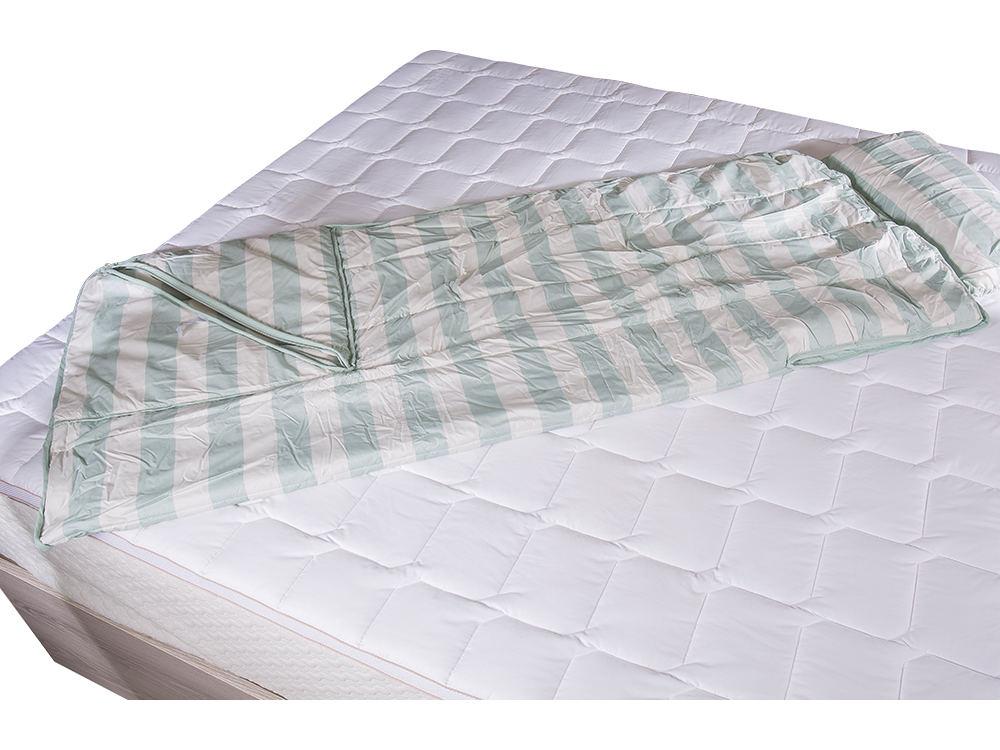
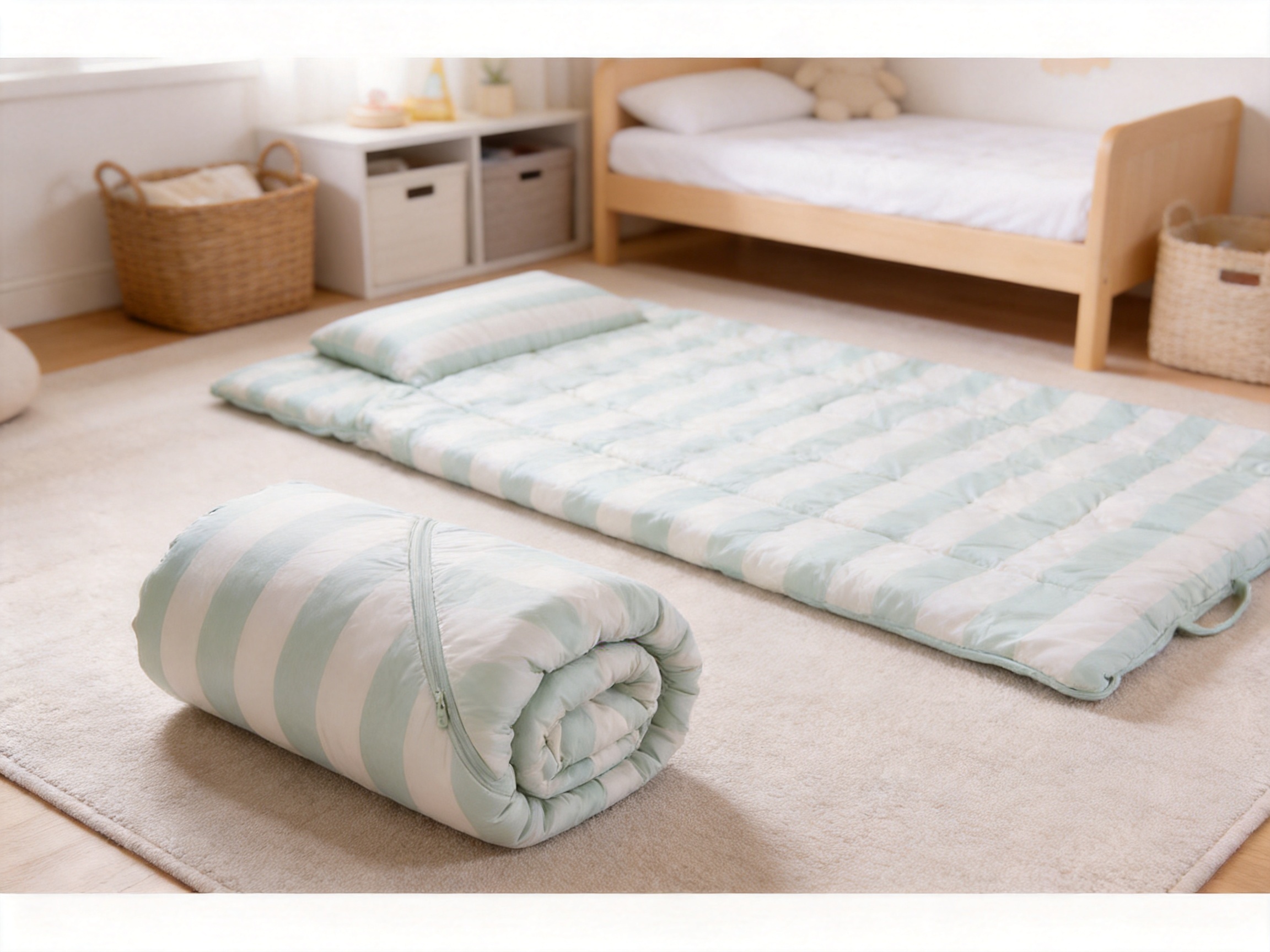
When folded and secured with its zipper, the product functions as a compact sleeping bag. When the zipper is opened, it becomes a children’s quilt measuring approximately 130 by 150 centimeters in its default configuration. This two-in-one structure gives the product a practical advantage over conventional bedding that can be used for only one purpose. It can support overnight sleeping, travel, daycare rest periods, home use, visiting family members, camping-style indoor activities, and temporary sleeping arrangements.
The product is categorized as a microfiber quilt and uses a 90gsm printed brushed fabric exterior together with a 150gsm 3D cotton lining. This combination is intended to balance softness, warmth, lightness, visual appeal, and everyday usability. The size can also be customized, allowing buyers to adapt the product to different age groups, market requirements, packaging plans, and sales channels.
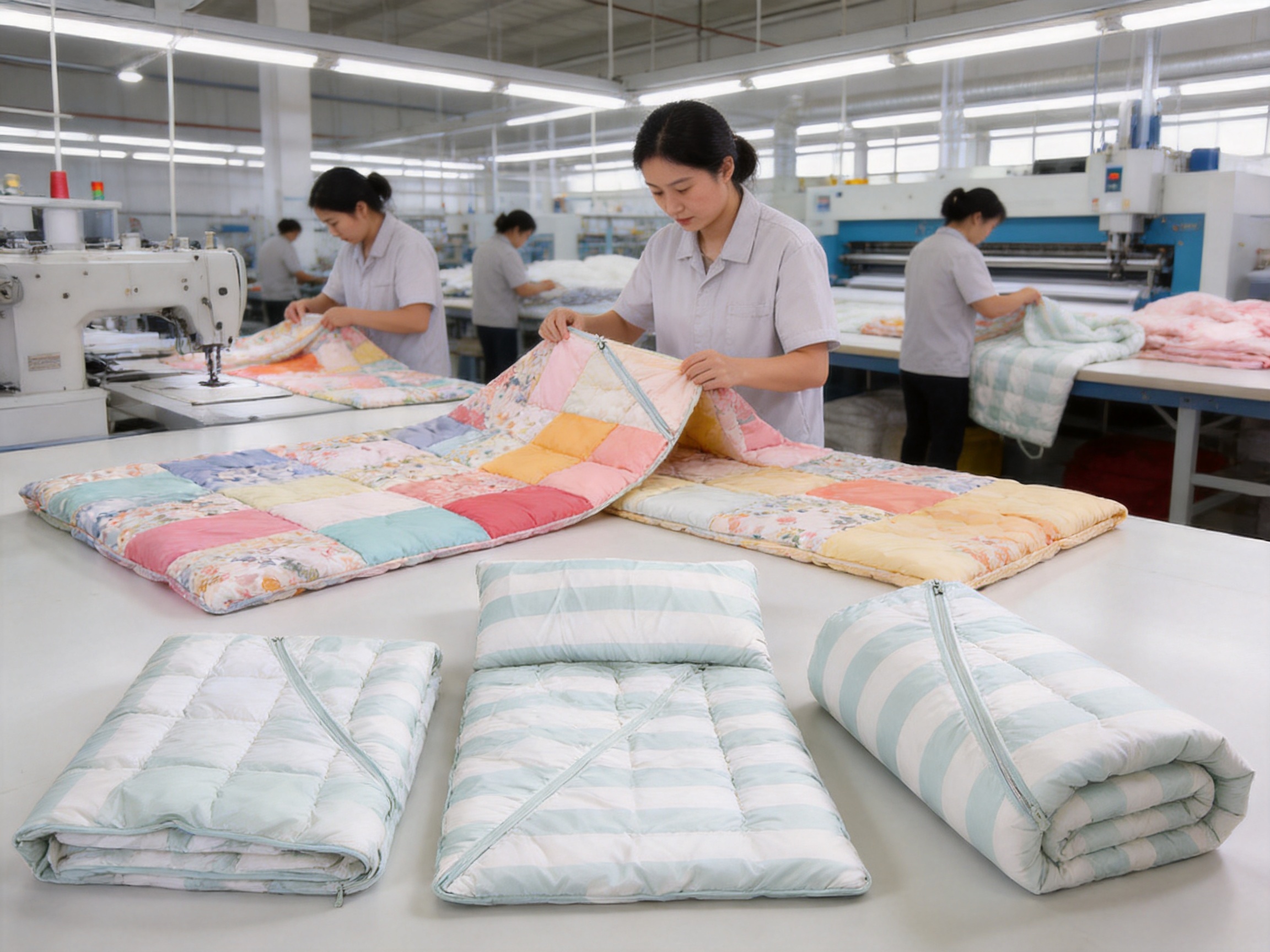
Manufactured by Tongxiang Xinlong Bedding Co., Ltd., the product benefits from the experience of a specialized home textile manufacturer with a large production site, a substantial workforce, professional technical personnel, and a broad product portfolio. The company’s manufacturing capabilities include quilts, pillows, cushions, bedspreads, travel quilts, mattress protectors, blankets, quilt and pillowcases, curtains, and other household textile products. This broad experience helps support the development of bedding products that are practical, commercially adaptable, and suitable for different customer requirements.
Multifunctional Children's Sleeping Bag
What Makes the Multifunctional Design Valuable?
The central feature of this product is its convertible construction. A traditional quilt is usually intended to lie flat on a bed, sofa, or other sleeping surface. A standard sleeping bag, by contrast, is designed to surround the user and maintain a more enclosed sleeping position. The Multifunctional Children’s Sleeping Bag brings these two formats together in one product.
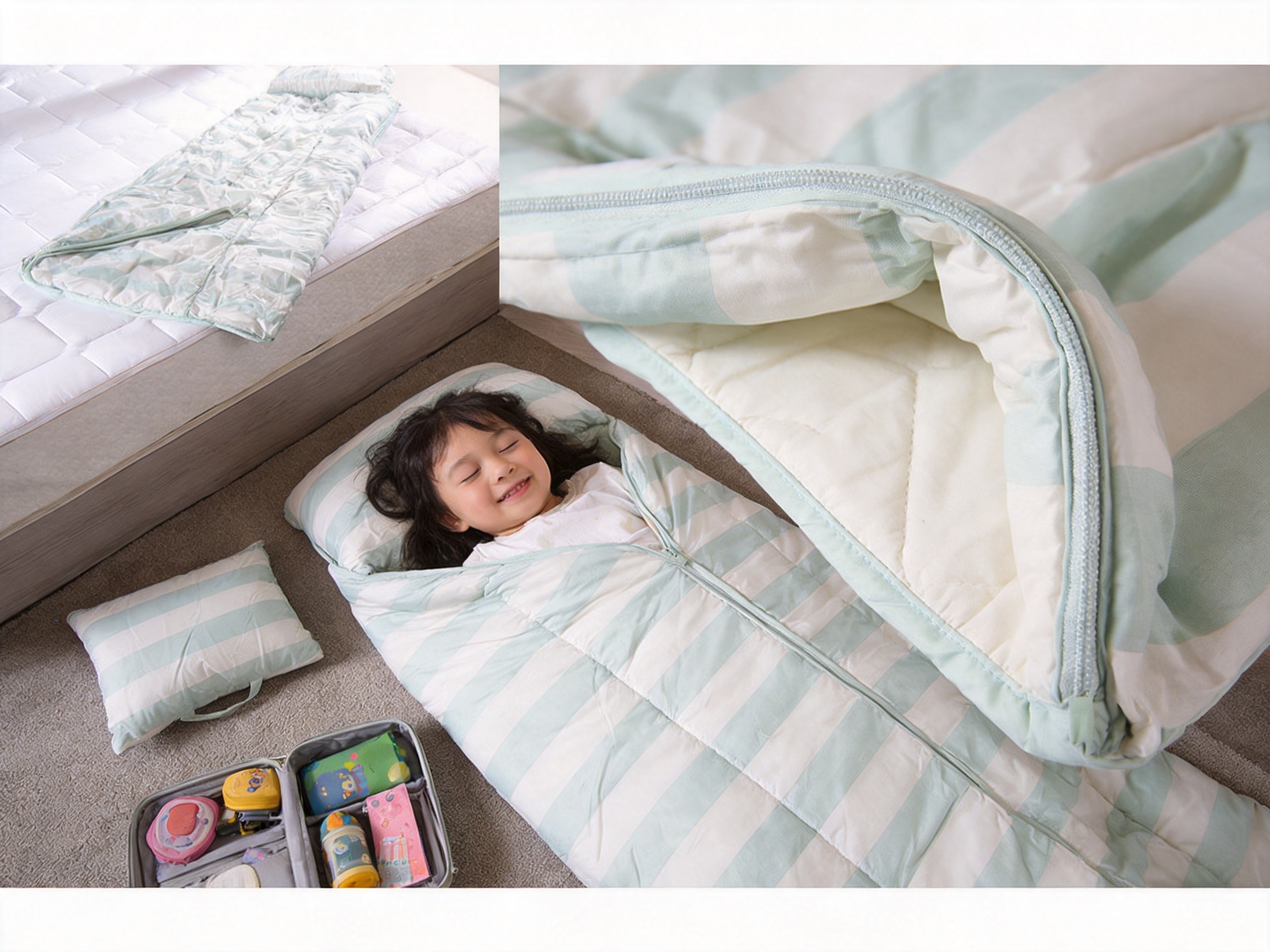
In sleeping bag form, the product provides a contained sleeping area that can help children feel secure and comfortable during rest. The zipped structure is convenient for sleepovers, travel, indoor recreation, guest accommodation, and children’s activity areas. It also reduces the number of separate bedding items that need to be carried or stored.
In quilt form, the same product can be spread across a bed or other sleeping surface. Opening the zipper creates a broader covering that can be used as a conventional children’s quilt. This makes the item more adaptable than a single-purpose sleeping bag, especially for households where children may use different sleeping arrangements throughout the day or week.
This multifunctional concept can also help simplify product selection. Instead of purchasing a separate sleeping bag for travel and a separate quilt for home use, customers can choose one product capable of performing both roles. For retailers and distributors, the two-in-one function provides a clear selling point that can be communicated easily through product displays, online listings, packaging, and demonstrations.
The convertible format may also support more efficient storage. When folded into sleeping bag form, the product can be handled as a single compact bedding item. When opened, it offers the coverage expected from a quilt. This flexibility is particularly useful in children’s rooms, dormitory-style accommodation, guest rooms, childcare settings, and homes where storage space is limited.
Product Specifications
The standard product configuration provides a practical foundation for wholesale and retail applications. Buyers may also discuss custom dimensions and other project-specific requirements with the manufacturer.
| Specification | Product Information |
|---|---|
| Product name | Multifunctional Children’s Sleeping Bag |
| Product category | Microfiber Quilt |
| Primary function | Sleeping bag and children’s quilt in one product |
| Default size | Approximately 130 x 150 centimeters |
| Custom sizing | Available according to project requirements |
| Outer fabric | 90gsm printed brushed fabric |
| Lining | 150gsm 3D cotton |
| Closure structure | Zipper-based convertible design |
| Suitable applications | Home use, travel, sleepovers, children’s rest areas, guest accommodation, and retail distribution |
The combination of a defined standard size and custom sizing gives buyers flexibility. A standard 130 by 150 centimeter format can simplify initial purchasing and product planning, while custom dimensions can help serve specific age groups, regional preferences, bedding systems, promotional programs, or institutional requirements.
Soft Printed Brushed Fabric for Everyday Comfort
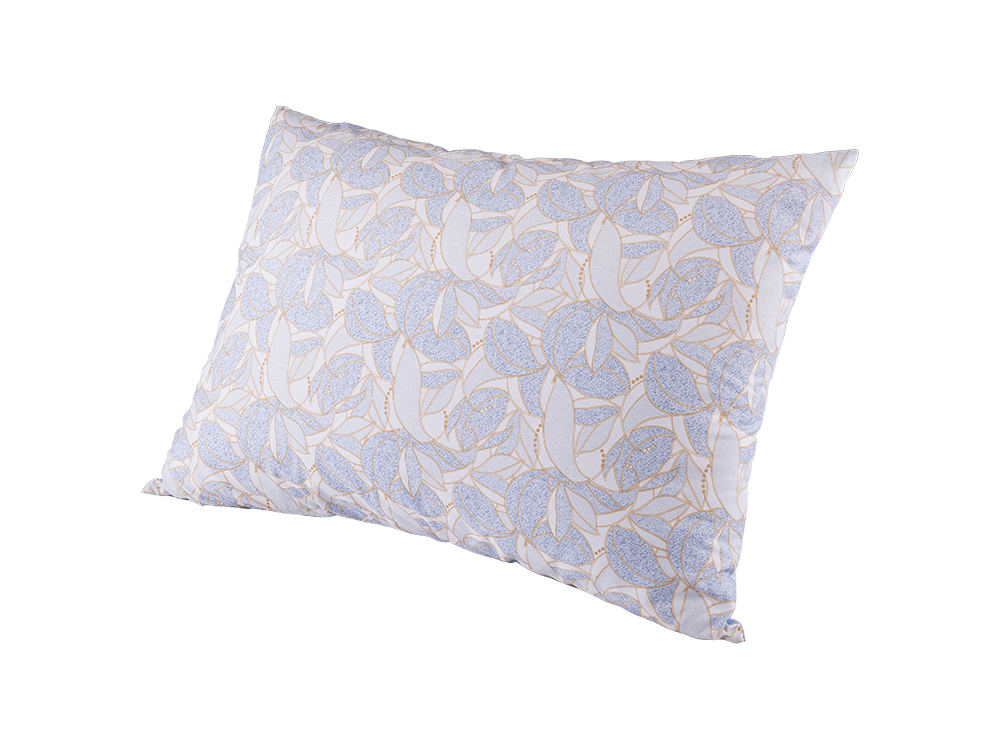
The outer fabric is a 90gsm printed brushed fabric. Brushing is a textile finishing process that raises or softens the surface fibers, creating a warmer and more comfortable hand feel than many smooth, untreated fabrics. For children’s bedding, surface comfort is particularly important because the product may come into frequent contact with the hands, face, arms, and other sensitive areas during sleep and rest.
The 90gsm fabric weight offers a balance between lightness and practical coverage. A fabric that is too heavy may make the product difficult for children to handle, while a fabric that is too light may not provide the desired structure or visual quality. The selected fabric construction helps the sleeping bag remain manageable while supporting an attractive finished appearance.
The printed surface also gives the product strong visual potential. Children’s bedding is often selected not only for its functional performance but also for its appearance. Printed fabric can support a variety of color schemes, motifs, and seasonal themes. This is useful for retailers seeking products that appeal to children and parents, as well as for distributors developing collections for different markets.
Printed designs can help distinguish the product from plain sleeping bags and basic quilts. They may also create opportunities for coordinated collections, such as matching children’s bedding, cushions, blankets, or other home textile items. The design direction can be selected according to target age, market positioning, store style, or seasonal merchandising needs.
Because the product is intended for children, visual design should be combined with responsible material selection and consistent production controls. Attractive printing is valuable, but it must be supported by reliable fabric preparation, controlled cutting, careful sewing, and appropriate inspection. A professional manufacturer can help buyers balance visual preferences with production feasibility and order requirements.
150gsm 3D Cotton Lining
The product uses a 150gsm 3D cotton lining. This lining contributes to the loft, softness, and cushioning effect of the bedding. The three-dimensional structure can help create a fuller feel than a flat, low-loft lining, giving the sleeping bag and quilt a more comfortable hand and appearance.
For children’s bedding, the internal filling or lining has a direct influence on the user experience. The material should feel soft without making the product unnecessarily bulky. It should also distribute evenly throughout the finished item so that some areas do not feel overly thin while others become excessively dense. Consistent filling and quilting practices are therefore important parts of the manufacturing process.
The 150gsm specification creates a useful balance for a multifunctional product. Since the item must work both as a sleeping bag and as a quilt, the inner material cannot be selected only for one form. It must remain flexible enough to fold, open, and move through the zipper structure while retaining a comfortable level of loft when spread out.
The lining also supports the product’s visual presentation. A well-formed interior helps the quilt maintain a neat shape and gives the sleeping bag a finished, substantial appearance. This is important for retail products, where customers often evaluate quality through touch, thickness, stitching, edge finishing, and overall construction before making a purchase.
Advantages Over Single-Purpose Bedding
The most direct advantage over conventional children’s quilts is versatility. A conventional quilt may provide comfortable coverage on a bed, but it does not normally offer the enclosed structure of a sleeping bag. The Multifunctional Children’s Sleeping Bag can be used in both formats, allowing one product to serve multiple daily and occasional purposes.
The product also has an advantage over many basic sleeping bags. A standard sleeping bag may be convenient for travel or camping-style activities, but it can be less suitable as a regular quilt. Once opened, the multifunctional product can provide broader coverage and a more familiar bedding arrangement. This gives parents and other users more options without requiring another separate textile item.
Another advantage is operational simplicity. A product that performs two functions can reduce the need to coordinate different bedding pieces for different situations. For families, this may make packing and storage easier. For schools, childcare centers, and hospitality providers, it may simplify inventory management. For retailers, it creates a product with a concise and understandable value proposition.
The design can also support better use of space. A child may use the item as a sleeping bag during a sleepover and later open it as a quilt at home. Rather than storing both products separately, the user can keep one convertible item available. This feature may appeal particularly to customers living in apartments, shared homes, compact bedrooms, or other spaces where efficient storage matters.
Cost efficiency may also be a consideration. The exact value depends on purchase price, order volume, materials, and market conditions, but a two-function product can offer more practical utility than a single-function item at a comparable level of purchase. For distributors, this may support a stronger product story and broader application range.
The multifunctional format can be especially attractive in gift markets. A children’s quilt may be viewed as useful, while a sleeping bag may be viewed as exciting or activity-oriented. Combining both functions gives the item a practical and engaging character that may appeal to parents, relatives, schools, and organizations purchasing children’s products.
Zipper Construction and Conversion Between Forms
The zipper is a key component of the product because it connects the two operating modes. In its closed configuration, it helps create the sleeping bag shape. When opened, it allows the item to spread into a quilt. The quality of the zipper installation and surrounding seam work therefore has an important influence on the overall user experience.
A well-managed conversion system should be easy for an adult to operate and sufficiently intuitive for older children under supervision. The zipper path should be aligned with the intended folding structure, and the surrounding fabric should be sewn securely to help maintain a neat appearance during repeated opening and closing.
Manufacturing attention is particularly important around zipper ends, corners, junctions, and areas exposed to pulling forces. These points may experience greater stress than the central panels of the quilt. Reinforced stitching, accurate positioning, and careful edge treatment can help support product durability and reduce the risk of unevenness or loose threads.
The zipper should also be considered as part of the overall comfort design. It should not create unnecessary bulk, sharp edges, or uncomfortable pressure points when the product is used as a sleeping bag. The manufacturer’s sampling and inspection processes can help evaluate the relationship between zipper position, fabric thickness, seam allowance, folding behavior, and user comfort.
For buyers developing customized versions, the zipper layout may be discussed during product development. Different markets may have different preferences regarding opening direction, sleeping bag shape, dimensions, decorative details, or packaging. Early technical communication can help make sure that the design remains functional after printing, cutting, filling, sewing, and final folding.
Applications Across Home and Commercial Settings
Home Bedrooms
In a home bedroom, the product can function as everyday children’s bedding. It may be placed on a child’s bed, used during rest periods, or stored for occasional use. When the child wants a more enclosed sleeping arrangement, the zipper can be closed to create a sleeping bag. When a broader cover is preferred, the product can be opened into a quilt.
Sleepovers and Visiting Friends
Sleepovers often require bedding that is easy to carry and quick to arrange. The sleeping bag configuration provides a practical format for moving the product from one room to another. After the sleepover, it can be opened, aired, folded, and stored as a quilt or general children’s blanket.
Travel and Family Trips
Families may use the product during domestic travel, visits to relatives, holiday accommodation, or indoor travel activities. It provides a familiar personal bedding item that can be adapted to different sleeping environments. The product’s two-in-one function means it can be used on a bed, sofa, floor mattress, or other suitable sleeping surface, depending on the setting.
Childcare and Rest Areas
Daycare centers, schools, and children’s activity facilities may require compact bedding that is easy to identify and store. The printed outer fabric can support visual differentiation, while the convertible format can provide a sleeping bag for individual use and a quilt for rest mats or broader sleeping surfaces.
Guest Rooms and Hospitality
Hotels, family guesthouses, holiday rentals, and other accommodation providers may use children’s sleeping bags as supplementary bedding. A multifunctional product can help hospitality operators offer a child-friendly sleeping option without maintaining two separate categories of children’s bedding.
Retail and Wholesale Distribution
For retailers, the product offers a clear demonstration opportunity. Staff can show how the item changes from a quilt to a sleeping bag, making its function easy for customers to understand. Online sellers can also present the two configurations in product photography and clear written descriptions.
Manufacturing Experience and Production Capability
Tongxiang Xinlong Bedding Co., Ltd. was established in January 2002 and has developed extensive experience in the home textile sector. The company is located in Wuzhen Town, Tongxiang City, Zhejiang Province, China, an area associated with textile manufacturing and home furnishing production.
The company covers approximately 21,000 square meters, with a construction area of approximately 18,000 square meters. It has more than 320 employees and is equipped with a range of production equipment for home textile manufacturing. This scale provides a foundation for handling product development, material preparation, cutting, sewing, filling, finishing, inspection, and order coordination.
Large-scale manufacturing is valuable for multifunctional bedding because the product requires coordination among several production stages. Fabric appearance, lining consistency, zipper alignment, seam strength, folding dimensions, and final presentation must work together. A manufacturer with experience across multiple bedding categories can use its broader technical knowledge to manage these relationships.
The company’s product portfolio includes silk cotton quilts, chemical fiber quilts, pillows, cushions, bedspreads, travel quilts, mattress protectors, blankets, quilt and pillowcases, shower curtains, curtains, and other home textile products. This category diversity demonstrates experience with different fabrics, fillings, construction methods, finishing requirements, and customer applications.
Experience with travel quilts and other portable bedding products is particularly relevant to a children’s sleeping bag. Portable bedding must be designed with attention to handling, folding, packaging, weight, and repeated use. Knowledge gained from related products can support the development of a sleeping bag that remains practical when moved between rooms or taken on trips.
Professional Technical Personnel and Product Development
Home textile manufacturing is not limited to operating sewing equipment. Product performance depends on decisions made during design and sampling. Fabric weight, lining selection, seam placement, zipper structure, dimensions, edge finishing, and packaging all influence the final result.
The company maintains professional and technical personnel to support product design and production. This capability can help customers develop products for different markets and specifications. For a multifunctional children’s sleeping bag, technical input is important because the product must function correctly in both its folded and unfolded states.
During product development, a manufacturer may evaluate how the fabric behaves after printing, whether the lining distributes evenly, how the zipper affects folding, whether the finished size matches the requested dimensions, and how the product appears after packaging. Sampling provides an opportunity to identify adjustments before larger production quantities are manufactured.
Technical coordination is also useful when customers request custom sizing. Changing the width or length can affect zipper placement, fabric consumption, filling distribution, folding methods, packaging dimensions, and shipping efficiency. A professional production team can review these factors and help align the custom design with practical manufacturing requirements.
Product development may also involve communication about target markets. A buyer supplying home retailers may want a different printed style and package format from a buyer serving educational institutions or hospitality providers. The product’s core design can remain recognizable while details are adapted to different commercial purposes.
Manufacturing Process for the Convertible Bedding Product
Material Planning and Fabric Preparation
Production begins with material planning. The requested size, quantity, fabric type, printed design, lining specification, zipper requirements, packaging method, and delivery schedule must be reviewed before cutting begins. Accurate planning helps reduce material waste and supports consistent production.
The printed brushed fabric should be checked for color consistency, surface quality, width, and visible defects. The lining should be checked for uniformity, weight, and suitability for the intended construction. When fabric is prepared carefully, later stages such as cutting and sewing can proceed more efficiently.
Printing and Color Management
Because the product uses printed outer fabric, color management is an important part of product presentation. Customers may require a specific design, color family, or collection theme. Production teams need to coordinate the approved artwork, fabric type, printing requirements, and sample confirmation.
Consistent printing helps maintain a uniform appearance across an order. It is especially important when several pieces are displayed together in a retail environment. A stable printed surface also supports the product’s visual identity and helps customers recognize the sleeping bag as a children’s bedding item rather than a generic blanket.
Pattern Making and Cutting
Pattern making determines the relationship between the quilt panel, sleeping bag shape, zipper position, seam allowances, and final dimensions. Accurate patterns are essential because a small error can affect the alignment of the outer fabric, lining, zipper, and edge binding.
During cutting, fabric panels should be prepared according to the approved pattern and production plan. Printed designs may require additional attention to direction, repeat, and panel alignment. Consistent cutting contributes to uniform finished sizes and helps reduce variation across a production batch.
Filling and Layer Assembly
The 150gsm 3D cotton lining must be positioned evenly between the relevant textile layers. Uneven placement can influence thickness, appearance, comfort, and folding behavior. The assembly process should therefore be managed carefully to ensure that the lining remains properly distributed before and during sewing.
For a convertible item, layer assembly must also consider the zipper area. Excess material near the zipper may affect smooth operation, while insufficient material may reduce the desired fullness or create an untidy edge. Coordinating the lining with the zipper structure is one of the technical details that distinguishes multifunctional bedding from a simple flat quilt.
Sewing and Edge Finishing
Sewing joins the fabric, lining, zipper, and structural components into a finished product. Stitch consistency, seam alignment, thread tension, and edge finishing all contribute to the appearance and functional reliability of the bedding.
Edges and corners should be finished neatly because they are visible in both quilt and sleeping bag configurations. Loose threads, uneven seams, or poorly aligned corners can reduce the perceived quality of the product. Professional inspection during sewing can identify issues early, when corrections are easier to make.
Zipper Installation
The zipper is installed according to the approved construction plan. Its position must allow the product to close into a sleeping bag and open into a quilt without creating excessive strain. The zipper tape should be aligned with the fabric panels, and the surrounding seams should be secured appropriately.
Samples can be opened and closed repeatedly to review the smoothness of conversion. This type of practical checking is valuable because a product may appear correct when laid flat but behave differently when folded or zipped. Testing the actual use process helps connect factory construction with the customer’s daily experience.
Final Inspection and Packing
After sewing and finishing, products can be checked for dimensions, appearance, zipper operation, stitching quality, fabric condition, filling distribution, and packaging requirements. The final folding method should reflect the product’s intended sales and storage format.
Careful packing helps protect the printed fabric and maintain a neat presentation during handling and transportation. It also supports efficient warehousing and retail display. Buyers with special packaging requirements can discuss labels, folding methods, quantities per carton, and other order details during production planning.
Quality Management and International Certifications
Quality management is an important part of consistent home textile production. Tongxiang Xinlong Bedding Co., Ltd. identifies quality as a core business principle and works to standardize operating procedures, improve employee technical skills, and enhance product quality.
The company has passed international certifications and management evaluations including ISO 9001, ISO 14001, OEKO-TEX standards, OEKO-TEX STeP, GRS, and BSCI, according to the supplied company information. These certifications and assessments represent structured approaches to quality, environmental management, textile-related standards, recycled material systems where applicable, and social compliance.
Certification does not replace product-specific inspection, but it can provide customers with additional confidence in the manufacturer’s management systems. For buyers developing children’s bedding, a structured production environment is valuable because multiple factors must be controlled at the same time, including materials, workmanship, documentation, worker procedures, and order consistency.
ISO 9001 is associated with quality management systems and process control. ISO 14001 is associated with environmental management systems. OEKO-TEX-related standards address aspects of textile safety and responsible production depending on the applicable certification scope. GRS relates to recycled materials and chain-of-custody requirements when relevant. BSCI is associated with social compliance and responsible working conditions.
Customers should confirm the specific certification scope, validity, and applicability to each order or material when necessary. Nevertheless, the company’s stated certifications demonstrate its efforts to operate according to recognized international frameworks and to serve customers with professional manufacturing systems.
Environmental and Responsible Production Considerations
Modern home textile buyers increasingly consider more than price and appearance. They may also evaluate environmental management, social responsibility, material traceability, production efficiency, and supplier transparency. A manufacturer’s experience with ISO 14001, GRS, OEKO-TEX-related systems, and BSCI can be relevant during supplier qualification and procurement review.
The product itself can support practical consumption by combining two bedding functions into one item. A customer who uses one convertible product instead of purchasing separate sleeping and quilt products may reduce the number of items needed for certain applications. The actual environmental benefit depends on product lifespan, care practices, material choices, transportation, and end-of-life handling, but multifunctional design is a useful part of efficient product planning.
Responsible production also includes reducing avoidable material waste through accurate pattern planning, managing fabric usage, organizing production flow, and maintaining reliable inspection procedures. These efforts can help support consistent quality while improving manufacturing efficiency.
For custom orders, buyers may discuss material preferences, packaging choices, recycled content requirements, and documentation needs with the manufacturer. Such communication should take place before production so that the requested specifications can be evaluated for technical feasibility and certification relevance.
Why Custom Sizing Matters
The default size of approximately 130 by 150 centimeters provides a practical starting point for many children’s bedding applications. However, children differ in age, height, sleeping habits, and the type of bed or mat used. Custom sizing enables buyers to create a product that better matches a particular market segment or institutional setting.
A shorter or narrower format may be appropriate for younger children or compact rest areas. A larger format may be preferred for older children, shared bedding systems, or customers who want additional coverage when the item is opened as a quilt. The appropriate size should be determined by the intended use, target user, storage method, and packaging plan.
Custom sizing may also be valuable for private-label collections, hospitality programs, school projects, promotional campaigns, and regional product lines. The manufacturer can review the requested dimensions and assess the impact on fabric consumption, zipper length, lining distribution, sewing procedures, carton size, and shipping volume.
Buyers should provide clear technical information when requesting customization. Useful details may include the finished open size, preferred sleeping bag dimensions, zipper direction, fabric artwork, lining specification, packaging format, labeling, order quantity, and required delivery schedule. Early communication reduces the risk of misunderstandings and supports more accurate sampling.
Commercial Advantages for Retailers and Distributors
A multifunctional product can make merchandising more effective because its benefit is easy to demonstrate. Retail staff can show the sleeping bag form and then open the zipper to reveal the quilt form. This physical transformation gives the product an interactive quality that may attract attention in stores, showrooms, exhibitions, and sales presentations.
Online retailers can also communicate the product’s value through a sequence of product images, size information, feature summaries, and use-case descriptions. The convertible design provides multiple content angles, including children’s bedding, travel bedding, sleepover accessories, guest bedding, and compact home textile solutions.
For distributors, product versatility can broaden the potential customer base. The same core item may be offered to household retailers, children’s product stores, department stores, online marketplaces, hospitality suppliers, educational organizations, and promotional product buyers. This can reduce dependence on a single sales channel.
Custom sizing and printed fabric also support market differentiation. Instead of competing only on standard dimensions and plain colors, buyers can develop collections with different patterns, sizes, packaging, and target applications. This can help create a more distinctive product range while using a proven multifunctional structure.
The product’s classification as a microfiber quilt may also allow it to fit within existing bedding categories used by retailers and distributors. At the same time, its sleeping bag function gives it a distinctive feature that separates it from ordinary quilts. This combination can be useful for product catalog organization and promotional messaging.
Care, Handling, and Product Longevity
Like all textile products, the service life of the Multifunctional Children’s Sleeping Bag depends on proper handling, cleaning, storage, and use. Buyers should provide care instructions that match the final materials, printing process, lining, zipper, and construction. The manufacturer can assist with product-specific recommendations based on the approved sample and production specifications.
Users should operate the zipper carefully and avoid forcing it when fabric or lining is caught in the track. The product should be folded according to the intended structure, especially when being converted into sleeping bag form. Proper folding can reduce unnecessary stress on seams and help maintain a neat appearance.
After use, allowing the bedding to air and dry appropriately can support freshness. Storage should protect the item from excessive moisture, sharp objects, and conditions that may damage the fabric or zipper. Specific washing and drying instructions should always follow the care label or supplier guidance.
For institutional users, a documented handling procedure may help maintain consistency. Staff can inspect zippers, seams, labels, and general condition periodically. Early identification of damage can support timely repair or replacement and help protect the user experience.
How the Product Supports Different Customer Needs
Parents may value the product because it offers flexibility at home and during travel. Retailers may value it because the two-in-one design creates a clear selling point. Distributors may value it because custom sizing and printed fabric allow market adaptation. Hospitality operators may value it because it provides a child-friendly bedding option in a compact, manageable format.
Schools and childcare organizations may appreciate the ability to use the product for rest periods while storing it efficiently between uses. Gift buyers may be attracted to the combination of practical bedding and an engaging sleeping bag format. These different needs are supported by the same basic construction, which improves the product’s commercial versatility.
The company’s broader home textile experience further supports these applications. Since the manufacturer produces multiple types of bedding and household textile products, customers may be able to coordinate the sleeping bag with related product categories. This can be useful for developing complete collections or sourcing several home textile items from one experienced supplier.
Procurement Considerations for Wholesale Buyers
Wholesale buyers should begin by identifying the target users and intended applications. The standard 130 by 150 centimeter size may be suitable for many children, but the correct dimensions depend on the target age range and market expectations. Buyers should also confirm the desired fabric design, packaging, labeling, and order quantity.
Sample approval is an important step. Buyers should review the printed fabric, surface hand, lining thickness, zipper operation, open dimensions, sleeping bag dimensions, seams, corners, and final appearance. It is also useful to examine how the product folds and how much space it occupies in the selected package.
Order planning should account for production lead time, material preparation, printing, sample confirmation, manufacturing, inspection, packing, and transportation. Custom products may require additional time compared with standard items, especially when artwork, size, packaging, or material requirements are changed.
Buyers should also clarify the documentation required for their market. Depending on the destination and sales channel, this may include material information, care labels, packing lists, inspection reports, certification documents, testing records, or social compliance documentation. Discussing these requirements early can help avoid delays.
A professional supplier relationship should include clear communication about quality expectations. Buyers can provide reference samples, measurement tolerances, packaging drawings, artwork files, and inspection criteria. The manufacturer can then assess production feasibility and establish a consistent basis for manufacturing.
Q&A
What is the Multifunctional Children’s Sleeping Bag?
It is a convertible children’s bedding product that functions as a sleeping bag when zipped into its compact form and as a children’s quilt when the zipper is opened.
What is the standard size?
The default open size is approximately 130 by 150 centimeters. Custom sizes can be discussed according to the buyer’s requirements and intended application.
What materials are used?
The outer fabric is 90gsm printed brushed fabric, and the lining is 150gsm 3D cotton.
Is it a quilt or a sleeping bag?
It is both. The product is categorized as a microfiber quilt, but its zipper construction allows it to be used as a sleeping bag as well.
What are the main advantages over a regular quilt?
Unlike a regular quilt, it can create a more enclosed sleeping space when zipped. It is also convenient for travel, sleepovers, storage, and temporary sleeping arrangements.
What are the main advantages over a standard sleeping bag?
Unlike many single-purpose sleeping bags, it can be opened into a broader quilt for use on a bed, mat, sofa, or other suitable sleeping surface.
Can the size be customized?
Yes. The manufacturer states that custom sizing is available. Buyers should provide the desired open dimensions, sleeping bag dimensions, target users, and application details.
Can the printed design be customized?
The product uses printed brushed fabric, so buyers can discuss design and color requirements with the manufacturer. Artwork, color expectations, and production feasibility should be confirmed during sampling.
Is the product suitable for wholesale orders?
Yes. Its standard size, adaptable design, and broad range of possible applications make it suitable for retail, wholesale, hospitality, educational, childcare, and promotional programs.
What should buyers check in a sample?
Buyers should check fabric feel, print quality, lining distribution, zipper operation, stitching, edge finishing, open dimensions, sleeping bag dimensions, folding behavior, packaging, and overall appearance.
What manufacturing experience does the supplier have?
Tongxiang Xinlong Bedding Co., Ltd. was established in 2002 and produces a broad range of home textile products. The company has approximately 21,000 square meters of land area, approximately 18,000 square meters of construction area, more than 320 employees, production equipment, and professional technical personnel.
Which management systems and certifications are identified by the company?
The supplied company information identifies ISO 9001, ISO 14001, OEKO-TEX-related certifications, OEKO-TEX STeP, GRS, and BSCI. Buyers should confirm the current validity and specific scope of any certification required for an order.
How can the product be used in a childcare or school setting?
It can be used as a rest-period quilt or as a sleeping bag for individual children. Its convertible format can help institutions adapt the bedding to different sleeping surfaces and storage arrangements.
Does the product replace all other bedding?
It can perform two important functions, but the most suitable bedding depends on the child, season, sleeping environment, care requirements, and local product standards. Buyers should evaluate the product according to their specific use case.
How should buyers begin a custom project?
They should provide the target size, fabric preferences, printed artwork, lining requirements, zipper expectations, packaging details, order quantity, destination market, and delivery schedule. A sample should be approved before bulk production.
Conclusion
The Multifunctional Children’s Sleeping Bag offers a practical answer to the growing demand for flexible children’s bedding. Its convertible zipper structure allows it to operate as both a sleeping bag and a quilt, giving families and commercial users more functionality from one product. The default 130 by 150 centimeter size, customizable dimensions, printed brushed fabric, and 3D cotton lining provide a balanced foundation for comfort, visual appeal, and market adaptability.
Compared with single-purpose bedding, the product offers broader use potential. It can support home sleeping, travel, sleepovers, childcare, guest accommodation, retail sales, and wholesale distribution. Its compact and convertible format can also simplify storage, transportation, product selection, and merchandising.
The product is supported by the manufacturing experience of Tongxiang Xinlong Bedding Co., Ltd., a home textile producer established in 2002 with a substantial production site, more than 320 employees, professional technical personnel, and a diversified product portfolio. The company’s stated quality, environmental, textile, recycled-material, and social-compliance certifications provide an additional foundation for international customer cooperation.
For buyers seeking a children’s bedding item with clear differentiation, adaptable specifications, and multiple practical applications, this multifunctional design is a strong option. Its value comes not from a single feature but from the integration of comfort, conversion, customization, manufacturing experience, and commercial flexibility in one children’s home textile product.
References
1. Product specification information supplied for the Multifunctional Children’s Sleeping Bag, including size, fabric, lining, and product functions.
2. Company profile information supplied for Tongxiang Xinlong Bedding Co., Ltd., including company history, facilities, workforce, product categories, and manufacturing capabilities.
3. International Organization for Standardization. Quality management systems and ISO 9001 principles.
4. International Organization for Standardization. Environmental management systems and ISO 14001 principles.
5. OEKO-TEX Association. Textile safety and responsible textile production standards.
6. Sustainable Apparel Coalition and related industry resources. Responsible production and supply chain management principles.
7. Global Recycled Standard. Recycled material verification and chain-of-custody principles.
8. Business Social Compliance Initiative. Social compliance and responsible supply chain principles.


 +86-573-88798028