



 Français
 Español
 Deutsch
Content
Almost every week, a customer asks us the same small question: the topper is already on the bed, the protector is in hand, and nobody is quite sure which one belongs on top. It sounds like a minor detail until you have paid for both layers and want each of them to do the job you bought it for. After more than two decades of making mattress protectors and other bedding in Tongxiang, here is the answer we give, along with the few exceptions that genuinely matter.
Does the Mattress Protector Go Over the Topper?
Yes. In the standard setup, the mattress protector goes over the topper, and the fitted sheet goes over the protector.
The full order from bottom to top looks like this: mattress, mattress topper, mattress protector, fitted sheet, then your quilt or blankets.
Why that order? Because each layer has one job, and the jobs stack in a logical way. The topper changes how the bed feels — softer, firmer, cooler, more supportive. The protector changes what happens when something spills. The sheet is the part you actually touch, and the part you wash most often.
If the protector sat underneath the topper, liquid would have to travel through the topper before it ever reached the barrier. By then the damage is already done to the layer that is hardest to clean. A protector on top catches everything first, which is exactly what a washable barrier is for.
Why the Protector Sits Above, Not Below
The topper is the layer you cannot easily wash
Memory foam, latex, wool and down toppers usually cannot go into a washing machine, and even the ones that can will not survive frequent hot washes. A protector can be washed every week for years. Put the machine-washable layer where the mess happens.
Protection only works downward
A protector is designed to stop sweat, drinks, pet accidents and body oils from reaching whatever is beneath it. Position it under the topper and you are protecting the mattress but sacrificing the topper — the more expensive mistake in most bedrooms.
It keeps the topper from wandering
Most toppers are smooth on both sides and slide a little every night. A fitted protector with an elasticated skirt grips the topper and the mattress together, so the whole stack stays centred instead of drifting toward the headboard.
Laundry day stays simple
With the protector on top, stripping the bed means the sheet and the protector — nothing else. The topper stays in place for months, which also means less wear from repeated handling.
The Layering Order at a Glance
| Layer | Main job | What to check |
|---|---|---|
| Mattress | Structure and support | Depth, for the protector skirt |
| Mattress topper | Comfort, firmness, temperature | Thickness, which adds to total bed height |
| Mattress protector | Washable barrier against spills and sweat | Must fit over mattress plus topper |
| Fitted sheet | The sleeping surface | Deep enough to cover the protector corners |
When the Order Changes
There are a few real situations where the protector ends up below the topper. They are worth knowing so you do not assume you have done something wrong.
Full encasement for allergies
A zip-up encasement is a different product from a washable protector, and it belongs directly on the mattress. The usual arrangement is: encasement on the mattress, topper on the encasement, then a washable protector over the topper. Two products, two jobs — one seals the mattress, one washes often.
Toppers that already have a washable cover
Some toppers come with a removable, machine-washable cover. In that case a protector on top is still useful for spills, but it is optional rather than essential. If the cover is not removable, treat the protector as mandatory.
Very thick or pillow-top toppers
A three- or four-inch topper can push the total bed height beyond what a standard protector will stretch over. Measure the mattress depth plus the topper thickness before ordering, and if nothing standard fits, ask for a custom skirt depth. Buying one size up in a flat protector and tucking it in is a workable short-term fix, but a proper fit looks better and lasts longer.
Choosing a Protector That Fits Over a Topper
Start with height. A mattress that is 25 cm deep plus a 5 cm topper needs a protector that comfortably covers 30 cm, ideally with a little room to spare. Stretch knit skirts forgive a centimetre or two; woven ones do not.
Then think about fabric, because the layer closest to your skin changes how the bed sleeps. Cotton feels cool and breathes well, polyester-cotton blends are durable and easy to launder, and brushed polyester gives a soft, quiet surface at a lower cost. If you are weighing the trade-offs, our guide to cotton versus polyester protector materials walks through breathability, shrinkage and wash life in more detail.
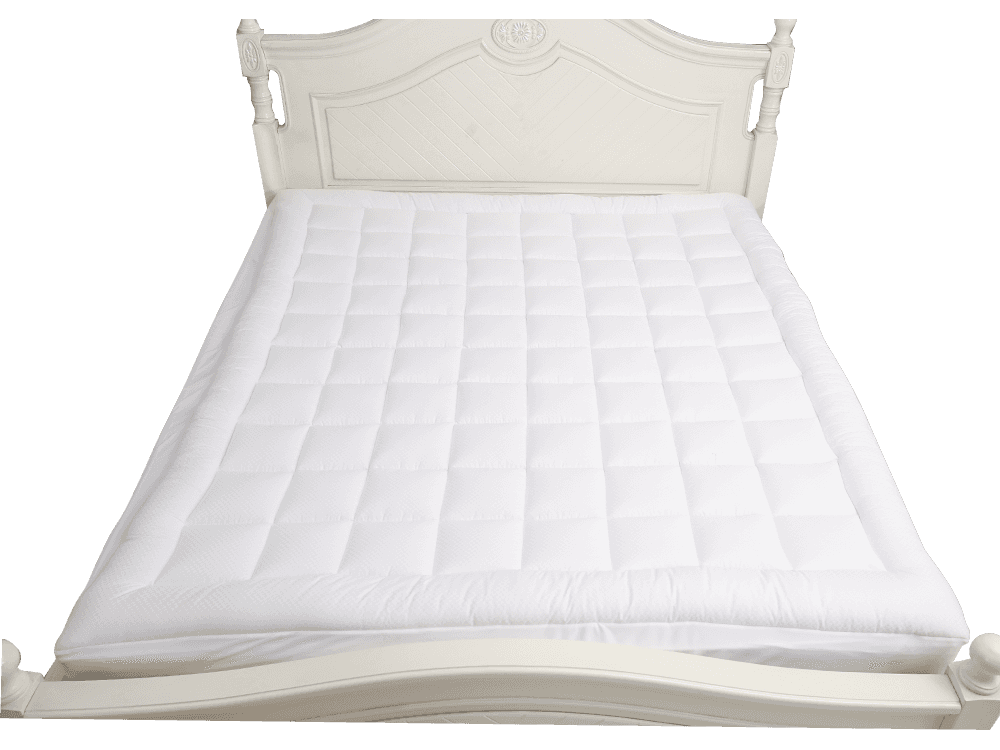 Premium Cotton Quilted Mattress ProtectorBreathable pure cotton and 600gsm 7D filling make this quilted protector a cool, cushioned choice for warm sleepers and sensitive skin.View Product →
For sleepers who run warm, a cotton protector with a breathable membrane is usually the better choice over memory foam, which already traps heat. Quilted cotton also adds a light cushioning layer without changing how the topper feels.
 Poly-Cotton Mattress Protector with Elastic FitA durable poly-cotton protector with 300gsm 6D filling and a secure elastic band, suited to family beds that see frequent washing.View Product →
A poly-cotton version is the practical middle ground for family beds and guest rooms: it survives frequent washing, dries faster than pure cotton, and holds its shape over a deep stack of mattress plus topper.
 Economical Polyester Mattress Protector and Bed SpreadA thin, moderately soft bedspread-style protector with 250gsm filling and a knitted skirt, useful as a light cover in spring and autumn.View Product →
Some households prefer a bedspread-style protector that doubles as a light cover during the day. That works well over a topper too, as long as the drop is long enough to reach below the mattress edge rather than stopping at the topper line.
Fitting It Without a Fight
- Unroll the topper and let it recover for a full day before fitting anything over it.
- Centre the topper on the mattress and check that no corner is hanging over the edge.
- Fit the protector corner by corner, pulling the skirt down past the topper and the mattress together.
- Smooth from the centre outward so trapped air escapes instead of forming ridges.
- Add the fitted sheet last, tucking the excess under the mattress rather than between the layers.
Washing and Care
- Wash the protector every one to two weeks, or weekly in summer and for allergy sufferers.
- Follow the care label; most protectors are happy at 40°C with a gentle cycle.
- Tumble dry low or line dry — high heat is what shortens the life of a waterproof membrane.
- Skip fabric softener, which coats the membrane and reduces breathability.
- Spot clean the topper and air it in shade rather than washing it unless the label allows.
Common Questions
Does a protector over a topper make the bed less comfortable?
Not if it fits properly. A thin, well-fitted protector barely changes the feel. A loose one wrinkles and creates pressure points, which is a fitting problem rather than a design problem.
Can I put the protector under the topper instead?
You can, and some people do it when a protector will not stretch over a very thick topper. Just remember that the topper then becomes the unprotected layer.
Do I still need a protector if the topper has its own cover?
It is a sensible addition. Covers are usually washable but not waterproof, so a spill will still reach the foam.
How often should the whole stack be taken apart?
Every two to three months, lift the topper, air it, and check the mattress underneath for moisture or dust before refitting everything.
A Note From Our Workshop
We have been making mattress protectors, quilts, pillows and blankets since 2002, and this question comes up in nearly every buyer conversation we have. The order itself rarely changes: topper on the mattress, protector on the topper, sheet on the protector. What does change is the size and fabric needed to make that order work on a specific bed.
If your mattress and topper stack falls outside standard dimensions, or you need a specific skirt depth, feel free to get in touch with our team and send us the measurements. We will tell you honestly which construction suits your bed.


 +86-573-88798028
